
When speaking of wine, one word comes up time and again — almost like a signature: the grape variety. Behind this term lies a fundamental truth, without which it would be impossible to grasp the richness and diversity of wines. But what exactly does grape variety mean?
More than mere technical jargon, it’s a scientific concept that defines the pure identity and history of the vine itself.
Definition: What does “grape variety” mean?
In oenology, a grape variety refers to a specific type of vine cultivated to produce grapes intended for winemaking. Each one has its own unique identity: the shape of its leaves, the size of its grape clusters, the color of its skins, the aromatic intensity, tannic structure, or natural acidity.
Originally, the term described the entire plant, from its roots to its fruit. But in the 19th century, the phylloxera crisis—when this tiny aphid devastated European vineyards — forced winemakers to turn to grafting. European vines were grafted onto American rootstocks that were resistant to the insect. Since then, the word grape variety refers primarily to the grafted part: the specific type of vine that produces the grapes, and through them, the wine.
In essence, the grape variety is the soul of the vine, the blueprint of its fruit, and the first key to understanding a wine’s personality.
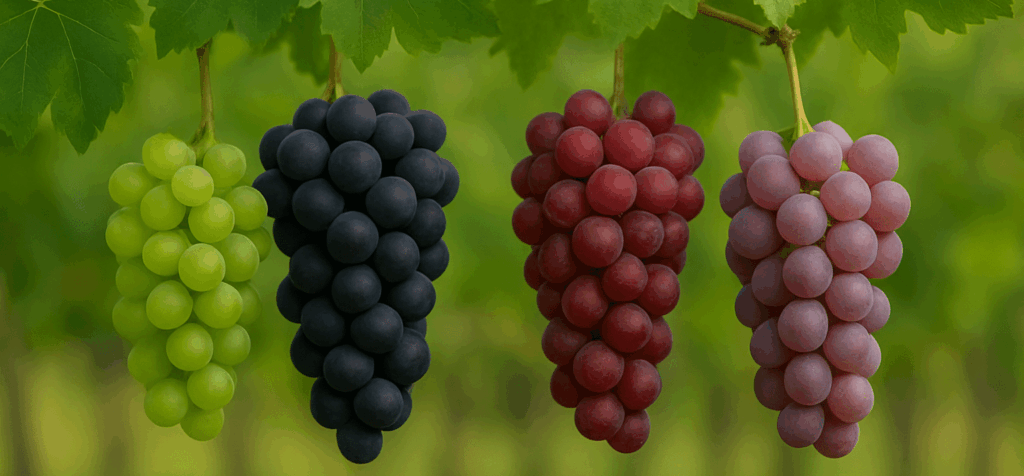
AI-generated image illustrating the various types of grape varieties.
The main families of grape varieties
Beyond individual varieties, several major vine families exist, each offering unique nuances to the wine world:
- Pinot, noble and refined, exists as Pinot Noir, Pinot Gris, and Pinot Blanc.
- Muscat, often exuberantly aromatic, includes Muscat of Alexandria, Muscat à Petits Grains, and Muscat Ottonel.
- Grenache, the emblematic grape of the Mediterranean, comes in black, grey, and white forms.
These subtle variations show that the concept of grape variety extends beyond simple classification. There are more than 6,000 varieties cultivated worldwide, each capable of shaping wines with vastly different characters.

What is ampelography?
The science devoted to identifying and classifying grape varieties is known as ampelography.
A true art of observation, it distinguishes varieties using precise criteria:
| Criterion | Influence on the Wine |
|---|---|
| Skin color | Defines whether it is a red or white grape variety |
| Skin thickness | Determines tannin richness and aromatic intensity |
| Leaf shape | Each variety has a characteristic leaf pattern |
| Berry size | Smaller berries concentrate aromas; larger ones are often used as table grapes |
| Chemical composition | Sugars, acidity, and aromatic compounds define the wine’s balance |
Recognizing a grape variety in a glass is a fascinating pursuit—requiring both an intimate understanding of terroirs and a finely tuned sensory intuition. It’s this balance between knowledge and instinct that creates the true magic of wine tasting.
What’s the difference between a grape variety and a wine name?
To truly understand what “grape variety” means, one must distinguish between the type of vine and the name of the wine itself.
In many New World countries, wines are named after their grape variety — Cabernet Sauvignon, Chardonnay, Syrah, and so on.
In France, particularly in great wine regions like Bordeaux, the focus is on the terroir. Rather than naming the grape, wines are labeled by their appellation — Médoc, Saint-Émilion, Pomerol, Graves, Sauternes…
Each appellation follows a strict set of regulations defining the grape varieties permitted.
For example, a red Bordeaux is typically a subtle blend of Merlot, Cabernet Sauvignon, and Cabernet Franc. This combination, carefully orchestrated by the winemaker, gives each wine its balance and personality.
Where the grape variety reveals typicity, the appellation embodies the harmony between variety, terroir, and tradition.
The most cultivated grape varieties
Around the world, certain grape varieties have become universal, while others remain deeply rooted in their regional heritage.
Red grape varieties grown in France:
- Merlot (Right Bank, Bordeaux)
- Grenache Noir (Rhône Valley / Languedoc)
- Syrah (Côtes du Rhône)
- Cabernet Sauvignon (Bordeaux)
- Cabernet Franc (Loire Valley)
- Carignan (Languedoc)
- Pinot Noir (Bourgogne)
- Gamay (Beaujolais)
White grape varieties:
- Ugni Blanc (Cognac, Armagnac)
- Chardonnay (Burgundy)
- Sauvignon Blanc (Loire Valley)
- Riesling (Alsace)
- Savagnin (Jura)
The revival of ancient grape varieties
While the great international varieties dominate vineyards, many producers are turning back to ancient grape varieties, sometimes long forgotten. Their renewed interest is driven by several factors:
- Natural resistance to disease and climatic challenges
- Contribution to the preservation of viticultural biodiversity
- Revival of original, surprising aromatic profiles
This return to the roots reflects winemakers’ desire to combine tradition and innovation in a way that respects the land and its history.
In summary: what does “grape variety” mean?
So, what does grape variety truly mean? It is the type of vine that, through its characteristics, imparts a distinct identity to the wine. Yet, its full expression only emerges through the meeting of terroir and craftsmanship.
The grape variety is a key to understanding wine—a thread linking land, climate, tradition, and human touch. To understand grape varieties is to step more deeply into the universe of wine, and to grasp the subtlety of its language.
The art of wine and the art of living with Maxwell-Baynes | Christie’s International Real Estate
If you’re still wondering what grape variety really means, consider it an invitation to discover the soul of a terroir — where every detail matters and every nuance reveals a unique identity.
In much the same way, Maxwell-Baynes | Christie’s International Real Estate highlights exceptional properties where architecture, landscape, and history intertwine to create an incomparable living experience.
Just as a fine wine expresses its terroir through its characteristics, each property represented by Maxwell-Baynes | Christie’s International Real Estate tells its own story—blending refinement, authenticity, and prestige.
