
We hold it without a thought. We uncork it, we pour it, we set it back down. The 75-centilitre bottle is so familiar that it has almost ceased to exist as an object; it has become, instead, a unit of measure for pleasure itself: six glasses, a dinner, an evening. And yet there is nothing self-evident about this figure. It is neither round, nor decimal, nor, on the face of it, logical. So why 75cl, and not a litre, far simpler to reckon with?
The answer lies not in some legend of a glassblower running out of breath, nor in any oenological wisdom about the ideal way to keep wine. It lies in a port, on a quay, between two languages and two systems of measurement.
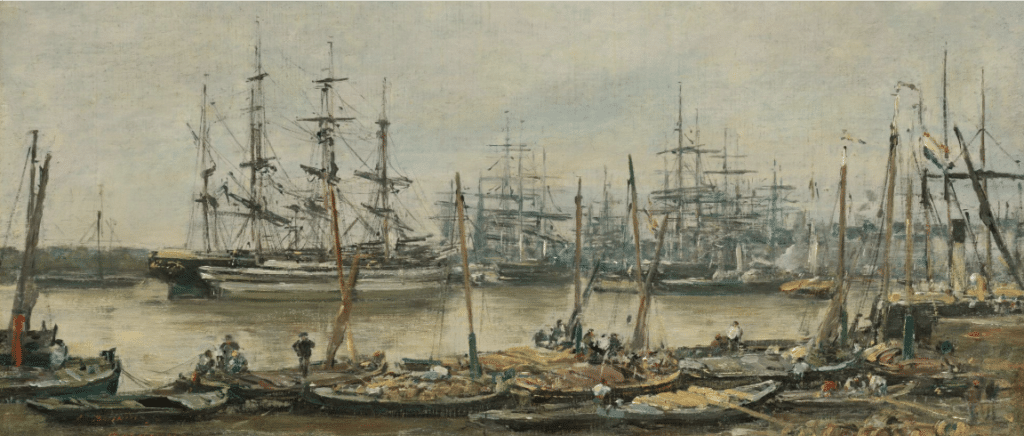
A Disagreement of Measures, Between Bordeaux and London
In the nineteenth century, England was Bordeaux’s foremost customer. The British merchants established along the quays of the Garonne bought in bulk, shipped by sea, and thought in imperial gallons, a unit with nothing whatsoever in common with the French litre: one imperial gallon equals 4.54609 litres. This measure was adopted in the nineteenth century by the winegrowers of Bordeaux and the British merchants of the city, at a time when the United Kingdom was the principal importer of French wines.
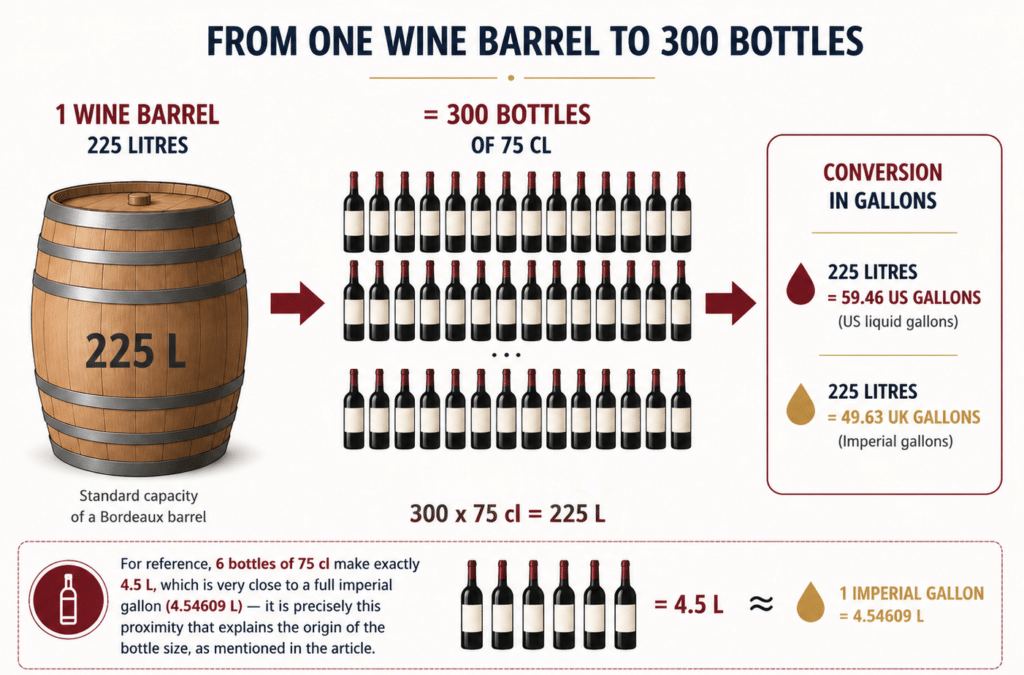
Wine, in those days, still travelled in the cask, the celebrated Bordeaux barrique of 225 litres, a calibre unchanged to this day. And so exports came to be standardised in barrels of 225 litres, the equivalent of 50 gallons: a reckoning that, almost miraculously, comes out round on both sides of the Channel. That left the question of how many bottles to draw from such a barrel. Three hundred is a far more manageable number than 225, and 225 litres divided into 300 equal parts yields, precisely, 75 centilitres.
There is nothing mystical, then, about the arithmetic: it is the plain arithmetic of commerce, devised so that the ledgers on both banks would agree without remainder or fraction. An 1866 law fixed the standard for the Bordeaux cask at 225 litres and gave prominence to a wine bottle of 75cl, inscribing in law what trade had already imposed in fact.
What 75cl Truly Owes to England
There is a second English debt, older still. Before the question of the gallon ever arose, the bottle first had to exist as we know it, rigid, dark, capable of ageing a wine rather than merely carrying it. That bottle was born in England: in 1632 the English diplomat Sir Kenelm Digby, who also owned a glassworks, devised the green- or brown-tinted wine bottle to shield its contents from the spoiling effects of light. Without this tinted, sturdy glass, the wine of Bordeaux could never have bided its time in the cellar, and the very idea of a standard vessel, one that could be transported and measured, would have made no sense at all.
The 75cl was not, then, born of a single gesture, but of the meeting between a craft, glass capable of preserving wine over time, and a necessity: to reconcile two economies that did not count in the same way.
The Legends We Like to Tell
Three stories still circulate at every table. The first would have 75cl match the breath of a glassblower, the lung capacity needed to blow a bottle before running out of air. The second sees in it the average a single guest might drink over a meal. The third, more scientific in appearance, claims it to be the optimal volume for the aging of wine.
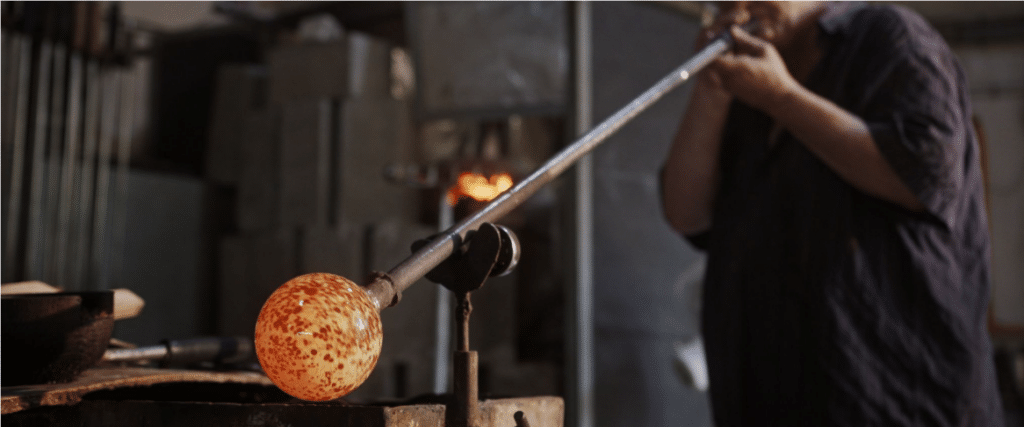
They endure because they are beautiful, and because they flatter the idea of a wine shaped by craftsmanship rather than by customs accountancy. The truth is less romantic, yet no less telling: it speaks of a wine already global before its time, already traded, already shipped on the scale of a commercial empire.
A Detail That Betrays the Origin: 73, 75, 77
A clue survives on certain very old labels, where one can still read “73cl”. This was no error: the bottle did hold 75cl of wine, but driving the cork home pushed part of it back out through the neck at the moment of filling, 2cl lost, thus, in the bottling. Since 1975, bottles have in fact been made with a capacity of 77cl, so that 75cl of wine will find their place once the cork is seated. This discreet figure, almost an aside, is the physical trace of a standard conceived down to its very last millilitres.
From Commercial Custom to Legal Standard
What began as no more than an arrangement between Bordeaux merchants and British buyers eventually became law. European Directive 75/107/EEC, adopted in December 1974 and published in the Official Journal in February 1975, formally regulated the bottles used as measuring containers across the Community, giving a common legal footing to what the wine trade had already practised for a century. A later regulation, which came into force in 2007, widened the range to eight official capacities, from 10cl to 1.5 litres, yet the 75cl has never surrendered its place as the reference.
What Remains, Today, in Our Glasses
The 75cl has outlived the abandonment of the gallon, the arrival of the metric system, two centuries of regulation. It has passed through every fashion without ever being called into question, to the point of becoming invisible, a measure one no longer measures, so completely has it merged with the very idea of wine.
What is striking in this story is not so much the figure as its reason for being. Bordeaux wine, in the end, invented without knowing it one of the very first international standards, long before the word itself existed.
The next time a bottle is uncorked at your table, it will carry with it a little of that old commerce, between the quays of the Garonne and those of London, a dialogue in figures, discreet, and yet still entirely of our own time.
Sources
- Council Directive 75/107/EEC of 19 December 1974, Official Journal of the European Union, L 42, 15.2.1975, EUR-Lex: https://eur-lex.europa.eu/legal-content/FR/TXT/?uri=CELEX:31975L0107
- Vinatis, « Pourquoi les bouteilles de vin font-elles 75 cl ? » : https://www.vinatis.com/blog-pourquoi-les-bouteilles-de-vin-font-elles-75cl
- Bernard Magrez, « Savez-vous pourquoi une bouteille de vin fait 75 cl » : https://bernard-magrez.com/vins/savez-vous-pourquoi-une-bouteille-de-vin-fait-75-cl/
- Château de Berne, « Pourquoi les bouteilles de vin font 75 cl ? » : https://chateauberne-vin.com/blogs/news/pourquoi-bouteilles-75-cl
- Chamvermeil, « La petite histoire de la bouteille de vin » : https://www.chamvermeil.com/fr-fr/blog/autour-de-la-vigne-et-du-vin/la-petite-histoire-de-la-bouteille-de-vin.htm
- Vino Lovers, « Pourquoi les bouteilles de vin font-elles 75 cl ? » : https://vino-lovers.com/blogs/conseils-astuces-vin/bouteilles-vin-75cl
- Vin de France, réglementation sur l’étiquetage et les contenances : https://www.vindefrance.com/pro/reglementation/bouteilles
