
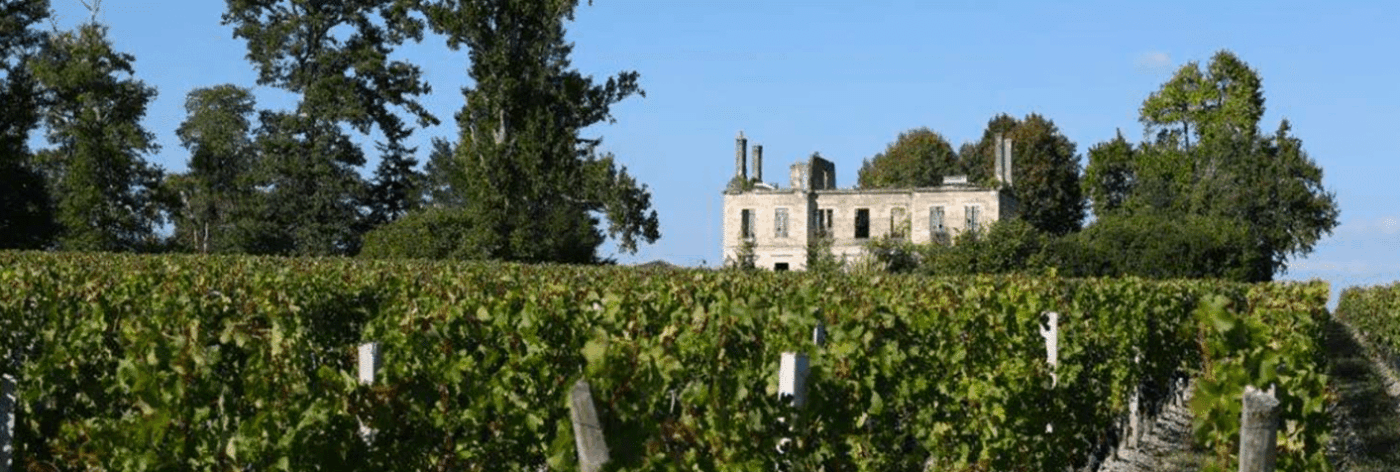
Pessac-Léognan sits at the southern edge of Bordeaux, where vineyards meet tramlines and suburban avenues. It is home to Château Haut-Brion, the only First Growth of 1855 outside the Médoc. It also produces some of the finest barrel-aged dry whites in France. Few appellations anywhere can claim such authority in both colours.
In Brief
- Location: ten communes south and southwest of Bordeaux, at the northern end of the Graves.
- Created: 9 September 1987, carved out of the Graves appellation.
- Size: around 1,880 hectares and some 70 châteaux, according to the Bordeaux Wine Council (CIVB).
- Wines: roughly 86% red, led by Cabernet Sauvignon and Merlot. The rest is dry white from Sauvignon Blanc and Sémillon.
- Classification: all 16 Crus Classés de Graves (1953, revised 1959) lie within Pessac-Léognan.
- Signature estate: Château Haut-Brion, First Growth in 1855.
What Is Pessac-Léognan Wine? A Definition
Pessac-Léognan wine is red or dry white wine produced under the Pessac-Léognan AOC. The appellation covers the historic heart of the Graves, on the left bank of the Garonne. Its reds are Cabernet-led blends with a distinctive smoky, mineral signature. Its whites blend Sauvignon Blanc and Sémillon, often fermented and aged in oak.
A young appellation carved out of the Graves in 1987
The appellation is barely four decades old. Before 1987, every estate here sold its wine as Graves. Growers in the northern Graves argued that their gravel terraces deserved distinct recognition. André Lurton, owner of Château La Louvière and Couhins-Lurton, led that campaign for years. The decree came on 9 September 1987. Since then, the vineyard has grown from about 800 hectares to nearly 1,900, largely on former forest land.
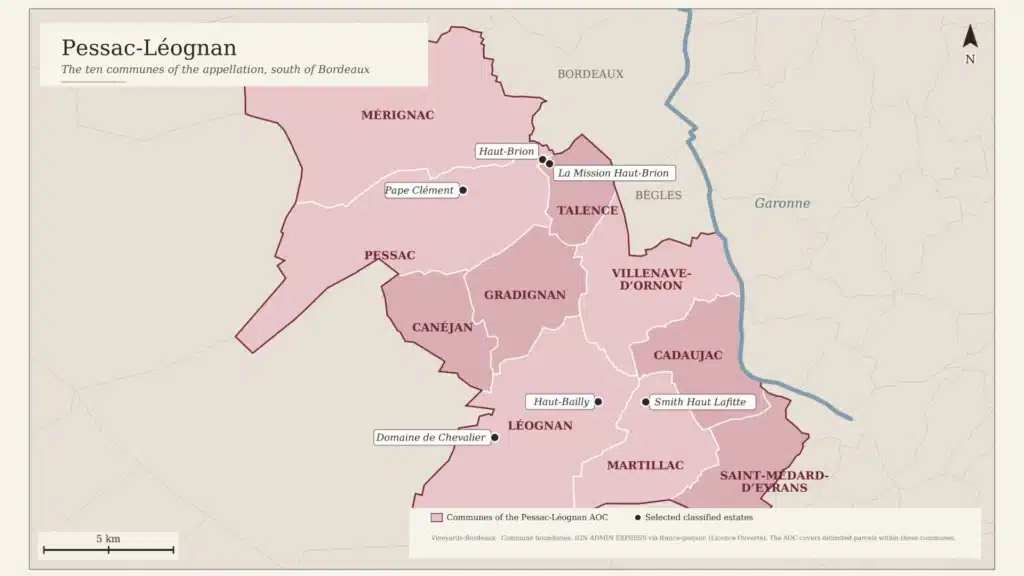
The northernmost appellation of the Graves, at the gates of Bordeaux
The ten communes are Pessac, Talence, Mérignac, Gradignan, Villenave-d’Ornon, Cadaujac, Léognan, Canéjan, Martillac and Saint-Médard-d’Eyrans. Several of them are now fully part of the Bordeaux metropolitan area. The wider Graves appellation continues to the south toward Langon. For a quick orientation on the region’s appellations, châteaux and volumes, our overview of the Bordeaux vineyards at a glance provides the essential numbers.
The History of Pessac-Léognan
Roman origins and medieval winemaking around Bordeaux
Vines likely grew around Burdigala, Roman Bordeaux, two thousand years ago. The land just outside the city walls became its first vineyard. Between 1152 and 1453, Bordeaux belonged to the English crown. Wine from the Graves shipped to London in great volume during those three centuries. In 1305, Bertrand de Goth, Archbishop of Bordeaux, became Pope Clement V. His vineyard in Pessac still bears his name: Château Pape Clément.
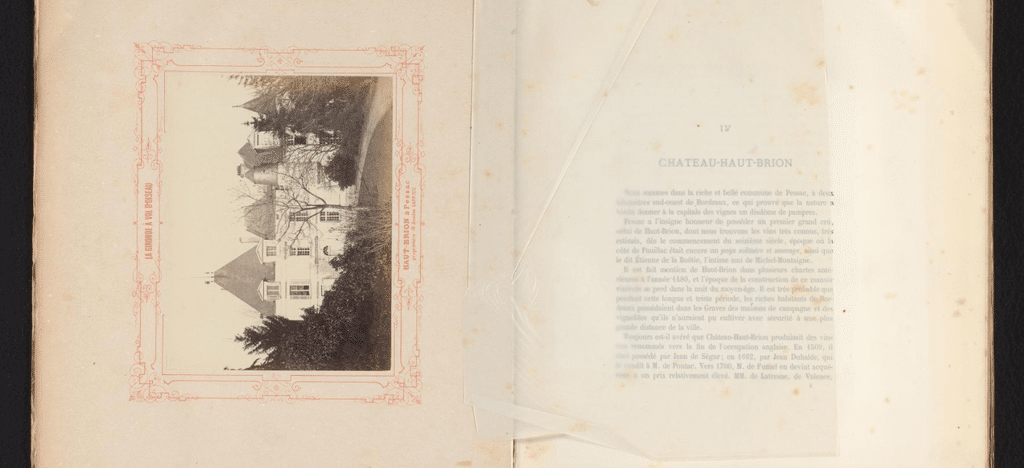
Haut-Brion in 1855: the only First Growth outside the Médoc
Jean de Pontac assembled the Haut-Brion estate in the 1520s and 1530s. A century later, his descendants sold their wine under the estate name in London. Samuel Pepys tasted “Ho Bryan” on 10 April 1663 and noted its singular taste. Thomas Jefferson visited on 25 May 1787 and shipped cases home to Virginia. When the 1855 Classification ranked the great red wines of Bordeaux, Haut-Brion was the only estate outside the Médoc admitted. It took its place among the First Growths.
The 1959 Graves Classification and the birth of Pessac-Léognan in 1987
The Graves received its own classification in 1953, revised in 1959. It distinguished estates for red wine, white wine, or both. Unlike the 1855 ranking, it set no internal hierarchy: every estate holds the same title, Cru Classé de Graves. All sixteen classified châteaux lie inside today’s Pessac-Léognan. That concentration of classified estates gave weight to the 1987 decision.
The Terroir of Pessac-Léognan
The famous “graves” of the Graves: gravel over sand and clay
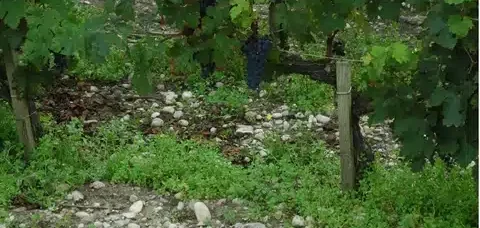
The region takes its name from its soil. Over millennia, the Garonne deposited gravel, pebbles and quartz across a series of terraces. In Pessac-Léognan, these deposits form low, well-drained mounds, rarely above 60 metres. Beneath the gravel lie layers of sand, clay and iron-rich hardpan. The deepest gravel sites favour Cabernet Sauvignon. Parcels with more clay and limestone often suit white varieties and Merlot.
A microclimate warmed by the city of Bordeaux
The urban mass of Bordeaux acts as a heat source. Estates in Pessac and Talence ripen earlier than those further south. Pessac-Léognan is often the first Bordeaux appellation to begin harvest. Pine forests to the west offer some shelter from Atlantic winds. This warmth gives the reds ripe fruit and supple tannins, even in cooler years.
Urban pressure and the shrinking vineyard
The city’s growth came at a heavy cost. Over the twentieth century, roughly 4,500 hectares of vines disappeared under housing, roads and commercial zones. Mérignac once had hundreds of hectares of vineyard; today it holds only a handful of estates. Land values near a major city exceed anything a vineyard can earn. Given how tightly the appellation is bordered by the city, availability is limited: our team monitors the Bordeaux vineyards currently available for acquisition and can flag rare Pessac-Léognan opportunities on request.
The Grape Varieties of Pessac-Léognan
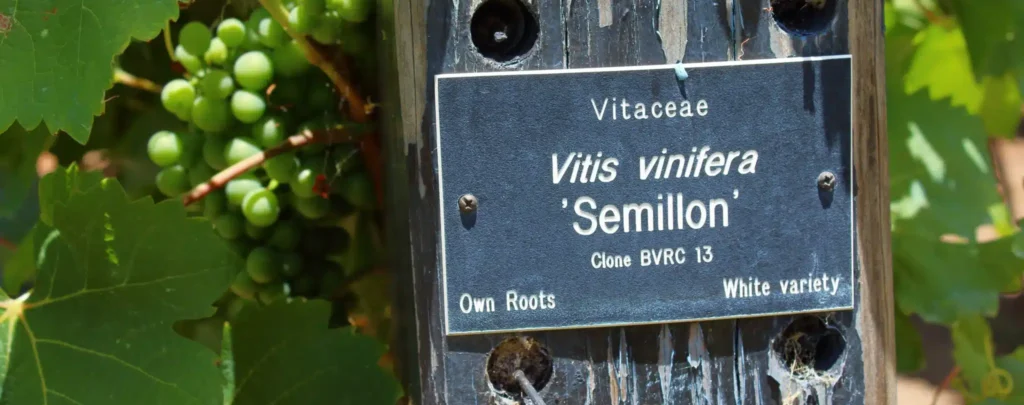
Red grapes: Cabernet Sauvignon, Merlot, Cabernet Franc
Cabernet Sauvignon and Merlot form the backbone of the reds. Their balance varies by estate: Haut-Brion currently plants slightly more Merlot than Cabernet. Cabernet Franc adds freshness and aromatic lift. Petit Verdot, Malbec and Carménère are permitted in small proportions.
White grapes: Sauvignon Blanc, Sémillon, Muscadelle
Sauvignon Blanc brings tension, citrus and aromatic precision. Sémillon adds texture, weight and the capacity to evolve over time. Sauvignon Gris and Muscadelle appear in small quantities on some estates.
| Grape variety | Colour | Typical share of the blend* |
|---|---|---|
| Cabernet Sauvignon | Red | 40 to 60% |
| Merlot | Red | 30 to 50% |
| Cabernet Franc | Red | 5 to 15% |
| Petit Verdot, Malbec, Carménère | Red | Under 5% |
| Sauvignon Blanc | White | 50 to 80% |
| Sémillon | White | 20 to 50% |
| Sauvignon Gris, Muscadelle | White | Under 10% |
*Indicative ranges. The appellation rules set no minimum share per variety, and each estate defines its own blend.
Pessac-Léognan Reds: Style and Character
Aromatic profile: smoky graphite, warm fruit, earthy complexity
A great Pessac-Léognan red is recognisable at the first nose. Tasters often describe notes of graphite, tobacco and warm brick. Ripe black fruit sits beneath a smoky, mineral frame. The tannins are fine and less austere than in the northern Médoc. With age, the wines develop earthy and truffle notes, with a savoury finish.
Ageing potential and legendary vintages
Classified reds typically reward 10 to 20 years of cellaring. The greatest estates can age for half a century in good conditions. Recent vintages of high standing include:
- Reds: 2005, 2009, 2010, 2015, 2016, 2018, 2019, 2020 and 2022.
- Whites: 2014, 2016, 2019, 2020 and 2021, the last marked by fresh, precise whites in a difficult year for reds.
Pessac-Léognan Whites: One of Bordeaux’s Best-Kept Secrets
Barrel-aged Sauvignon Blanc and Sémillon blends
The whites are the appellation’s quiet distinction. Few other Bordeaux appellations produce dry whites at this level with such consistency. Most top estates ferment their whites in oak barrels, then age them on the lees. This method builds texture and a subtle toasted complexity. The result combines citrus, white flowers, beeswax and a saline finish.
Why Pessac-Léognan whites can age for decades
Acidity from Sauvignon Blanc and structure from Sémillon give these wines a long life. Young, they show bright fruit and tension. After ten years, they gain notes of honey, hazelnut and dried citrus peel. Domaine de Chevalier Blanc and Haut-Brion Blanc are known to improve over thirty years or more.
How they compare to Burgundy and top Loire whites
The comparison with Burgundy is natural. Both regions produce barrel-aged dry whites built for the cellar. Burgundy relies on Chardonnay alone, while Pessac-Léognan builds its wines on a blend. Sancerre and Pouilly-Fumé in the Loire share the Sauvignon Blanc, yet most are unoaked and drunk younger. Haut-Brion Blanc ranks among the most expensive dry whites in the world, alongside the grand crus of the Côte de Beaune.
The Great Châteaux of Pessac-Léognan
Château Haut-Brion: the First Growth outside the Médoc
Haut-Brion has belonged to the Dillon family since 1935. Its vineyard lies within the town of Pessac, surrounded by houses and avenues. The red combines power with an unmistakable aromatic finesse. The white, produced from under three hectares of vines, is extremely rare. Haut-Brion holds a singular place in the 1855 Bordeaux Classification and the story of its five First Growths.
La Mission Haut-Brion: the sibling estate
Across the road stands La Mission Haut-Brion, long a rival of its neighbour. Domaine Clarence Dillon acquired it in 1983. Its red often shows more density and a darker fruit profile. Since the 2009 vintage, the former Laville Haut-Brion has been released as La Mission Haut-Brion Blanc. The vines of La Tour Haut-Brion were also absorbed into La Mission after 2005.
Domaine de Chevalier, Pape Clément, Smith Haut Lafitte and other classified estates
Domaine de Chevalier, in Léognan, is a reference for both colours, with a white of exceptional longevity. Château Pape Clément, in Pessac, carries seven centuries of history. Château Smith Haut Lafitte, in Martillac, has built a strong reputation since the Cathiard family’s arrival in 1990. While Château Haut-Bailly produces only red, and remains one of the most consistent wines in the appellation. Alongside these classified estates, dozens of other historic Bordeaux châteaux deserve attention, and our insider’s guide to Bordeaux wine estates covers the wider landscape.
The 1959 Graves Classification: red and white classifications
| Château | Red classification | White classification | Note |
|---|---|---|---|
| Haut-Brion | Yes | Yes | First Growth 1855; white added in 1960 |
| La Mission Haut-Brion | Yes | Yes* | *White classified as Laville Haut-Brion, renamed in 2009 |
| La Tour Haut-Brion | Yes | No | Merged into La Mission after 2005 |
| Bouscaut | Yes | Yes | Cadaujac |
| Carbonnieux | Yes | Yes | One of the largest white producers |
| Domaine de Chevalier | Yes | Yes | Benchmark white |
| Olivier | Yes | Yes | Moated medieval château |
| Malartic-Lagravière | Yes | Yes | Léognan |
| Latour-Martillac | Yes | Yes | Martillac |
| Haut-Bailly | Yes | No | Red only |
| Pape Clément | Yes | No | Named after Pope Clement V |
| Smith Haut Lafitte | Yes | No | Martillac |
| De Fieuzal | Yes | No | Léognan |
| Couhins | No | Yes | Villenave-d’Ornon |
| Couhins-Lurton | No | Yes | Villenave-d’Ornon |
How Much Does a Bottle of Pessac-Léognan Cost?
From entry-level Pessac-Léognan to Haut-Brion prices
Price ranges span a wide spectrum. Indicative US retail prices, per 75 cl bottle, run as follows:
- Entry-level Pessac-Léognan: about $25 to $50.
- Classified growths: about $50 to $150, with La Mission Haut-Brion well above this range.
- Château Haut-Brion (red): about $450 to $650 for recent vintages, considerably more for celebrated older years.
The most sought-after vintages are traditionally sold through the Bordeaux en primeur campaign, a mechanism we cover in detail.
The white wines: often overlooked, sometimes bargains
The classified whites often cost less than equivalent quality from Burgundy. Bottles from Carbonnieux, Latour-Martillac or Malartic-Lagravière remain accessible for wines of their pedigree. At the summit, the picture changes: Haut-Brion Blanc often sells above the estate’s red.
Visiting Pessac-Léognan: What You Need to Know
The most accessible appellation in Bordeaux (thanks to the city)
No other great Bordeaux appellation lies so close to the city centre. Several estates are fifteen to twenty minutes from the Place de la Bourse. Visitors can taste in the morning and return to the city for lunch. The appellation suits a short stay in Bordeaux without a hire car.
Notable châteaux open to visitors
Smith Haut Lafitte welcomes visitors and sits beside Les Sources de Caudalie, a hotel and spa among the vines. Pape Clément offers tours and tastings throughout the year. Carbonnieux and Domaine de Chevalier receive visitors by appointment. Château Les Carmes Haut-Brion, a small estate within Bordeaux itself, is known for its contemporary cellar. Haut-Brion opens mainly to trade professionals, by appointment only.
In Brief
- Pessac-Léognan was created in 1987 from the northern Graves, just south of Bordeaux.
- It is the only Bordeaux appellation with classified estates of the highest level in both red and dry white.
- Gravel terraces and a city-warmed climate produce smoky, refined reds and long-lived barrel-aged whites.
- All 16 Crus Classés de Graves lie within its borders, led by Château Haut-Brion.
- Prices range from about $25 to well over $500 per bottle.
- Urban growth keeps the vineyard rare and estates for sale exceptionally scarce.
FAQ : About Pessac-Léognan Wine
What is Pessac-Léognan wine exactly?
Pessac-Léognan wine is red or dry white wine from a Bordeaux appellation created in 1987. It covers ten communes south of the city, at the northern end of the Graves. Reds blend Cabernet Sauvignon and Merlot. Whites blend Sauvignon Blanc and Sémillon.
What is the difference between Pessac-Léognan and Graves?
Pessac-Léognan is a distinct appellation carved out of the northern Graves in 1987. Graves still exists as a separate AOC further south. Pessac-Léognan contains all sixteen classified Graves estates. It generally commands higher prices and stricter yields.
Which grapes are used in Pessac-Léognan wine?
Reds rely mainly on Cabernet Sauvignon and Merlot, with some Cabernet Franc. Petit Verdot, Malbec and Carménère are also allowed. Whites use Sauvignon Blanc and Sémillon, sometimes with Sauvignon Gris or Muscadelle.
Is Château Haut-Brion in Pessac-Léognan?
Yes. Château Haut-Brion lies in the town of Pessac, within the Pessac-Léognan appellation. It is the only First Growth of the 1855 Classification located outside the Médoc. It is also a Cru Classé de Graves for both red and white.
Are Pessac-Léognan whites really age-worthy?
Yes, the top whites are among the longest-lived dry whites in France. Their blend of Sauvignon Blanc acidity and Sémillon texture supports decades of evolution. Domaine de Chevalier Blanc and Haut-Brion Blanc can age for thirty years or more.
What is the best vintage of Pessac-Léognan wine?
For reds, 2005, 2009, 2010, 2016, 2019 and 2020 stand out. For whites, look to 2014, 2016, 2019, 2020 and 2021. Vintage quality can vary between estates, so producer reputation matters as much as the year.
How long can a Pessac-Léognan wine age?
Most classified reds drink well between 10 and 20 years after the vintage. The greatest estates can age for 50 years. Classified whites usually peak between 8 and 20 years, with exceptional bottles going further.
What food pairs well with Pessac-Léognan wine?
The reds suit lamb, duck breast, game birds and mushroom dishes. Their smoky profile also matches grilled beef. The whites pair with lobster, turbot, scallops, poultry in cream sauce and aged hard cheeses.
Conclusion
Pessac-Léognan rewards those who look beyond the Médoc and the Right Bank. Its reds carry the authority of Haut-Brion and three centuries of fame. Its whites remain one of the great discoveries of Bordeaux for collectors. The appellation also embodies a rare tension between vineyard and city. That scarcity gives every estate here particular value. Our team at Vineyards-Bordeaux follows this market closely and remains available to discuss any project in the appellation.
Sources
- Bordeaux Wine Council (CIVB), Pessac-Léognan appellation guide, bordeaux.com: https://www.bordeaux.com/en/designations/graves-sauternes/pessac-leognan/
- INAO, Cahier des charges de l’appellation d’origine contrôlée Pessac-Léognan: https://extranet.inao.gouv.fr/fichier/CDC—Pessac-Léognan—PNO-2024.pdf
- Decanter, Jane Anson, Pessac-Léognan at 30: https://www.decanter.com/wine-news/opinion/news-blogs-anson/anson-of-pessac-leognan-30-years-382039
- The Wine Cellar Insider, Learn about Pessac-Léognan and Graves: https://www.thewinecellarinsider.com/bordeaux-wine-producer-profiles/bordeaux/graves-pessac/
- The Wine Cellar Insider, 1959 Graves Classification: https://thewinecellarinsider.com/bordeaux-wine-producer-profiles/bordeaux/list-of-1959-graves-classifications
- Wikipedia, Classification of Graves wine: https://en.wikipedia.org/wiki/Classification_of_Graves_wine
- Wikipedia, Château Haut-Brion: https://en.wikipedia.org/wiki/Ch%C3%A2teau_Haut-Brion
- iDealwine, Pessac-Léognan, de grands bordeaux singuliers et abordables: https://www.idealwine.net/pessac-leognan-de-grands-bordeaux-singuliers-et-abordables/
- Wine Decider, Château Haut-Brion 2021 US prices: https://www.winedecider.com/en/find/chateau-haut-brion-pessac-leognan/2021/us/USD
