
Bordeaux Supérieur appears on millions of labels, yet few buyers know what the word “Supérieur” guarantees. The answer sits in a short legal text, the appellation’s cahier des charges, and it differs from much of what circulates online. This guide starts at the label and tests the quality question. It then follows the bottle back to the vineyards and the land market behind it.
In Brief
- Bordeaux Supérieur is a regional appellation created in 1943. It shares its delimited area with Bordeaux AOC and applies stricter production rules.
- It produces red wine and a rare sweet white. It makes no rosé.
- Reds are dry and Merlot-led. They must age until at least June 15 after the harvest, and producers cannot sell them before July 1.
- Quality varies by producer more than by appellation. The label, the vintage and the bottling method help you choose.
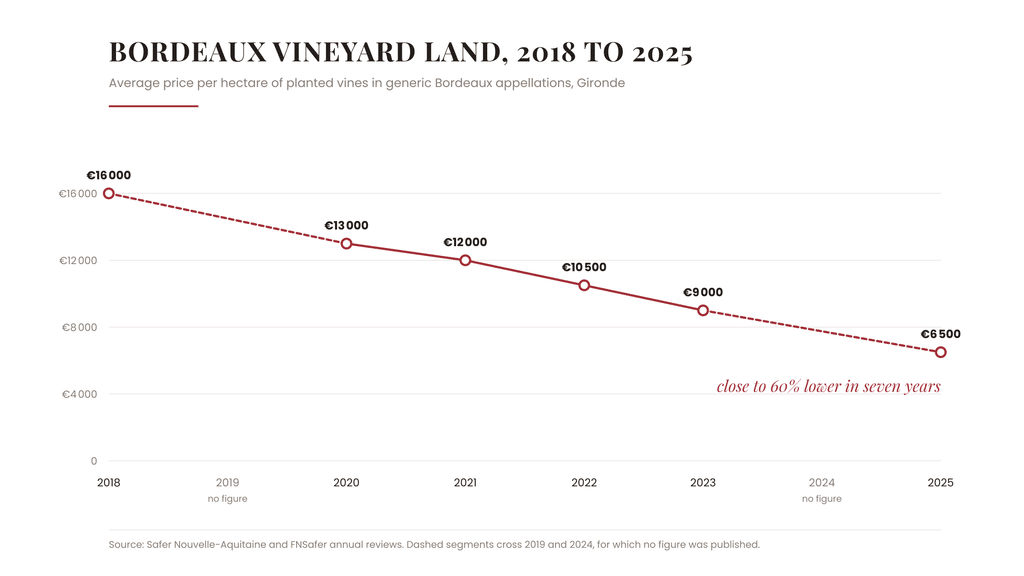
- Behind the label, the Gironde vineyard is restructuring. Land in generic Bordeaux appellations fell from €16,000 to €6,500 per hectare between 2018 and 2025.
What Is Bordeaux Supérieur?
A regional appellation created in 1943, one step above Bordeaux AOC
Bordeaux Supérieur is an appellation d’origine contrôlée (AOC), the French designation that ties a wine’s name to a defined area and a set of rules. It covers the same delimited area as Bordeaux AOC, which spans the entire Gironde département. Growers who meet tighter requirements may use the Supérieur name for the same land.
Many label readers assume “Supérieur” refers to a better terroir. It does not. The mention refers to stricter rules on planting, yield and ripeness, applied to the same ground.
Bordeaux vs Bordeaux Supérieur: the rules that make the difference
The two appellations differ in six measurable ways. The table compares them using each appellation’s published cahier des charges.
| Bordeaux AOC | Bordeaux Supérieur | |
|---|---|---|
| Colours allowed | Red, rosé, white (dry or sweet) | Red and white only |
| Minimum planting density (post-2008 plots) | 4,000 vines/ha | 4,500 vines/ha |
| Maximum yield, red | 60 hl/ha | 59 hl/ha |
| Maximum yield, white | 67 hl/ha | 49 hl/ha |
| Minimum natural alcohol | Red 10.5%, dry white 10% | Red 11%, white 12% |
| Residual sugar | Red and dry white 3 g/l or less | Red 3 g/l or less, white above 17 g/l |
| Minimum aging (élevage, the period between fermentation and bottling) | None stated | Red until June 15 after harvest, white until December 31 |
| Earliest release | None stated | Red July 1, white January 15 |
Sources: INAO product specifications, Bordeaux AOC and Bordeaux Supérieur. The Bordeaux AOC text dates from 2013 and the Bordeaux Supérieur text from 2018. Check both against the versions currently in force before publication.
The planting density rule matters most. A Supérieur red earns its 59 hectoliters per hectare only with at least 4,500 vines per hectare. Looser plantings carry a lower ceiling. Fewer hectoliters from the same vineyard concentrate the fruit.
The aging rule corrects a common error. Some sites state that Bordeaux Supérieur requires twelve months of barrel aging. The text sets a calendar date instead, June 15 of the year after harvest, and does not mandate oak.
Mostly red, occasionally a sweet white
Red wine makes up nearly all of the production. A few estates also make a white Bordeaux Supérieur. It breaks with expectations: it is a sweet wine, with residual sugar above 17 grams per liter, made from Sémillon, Sauvignon and Muscadelle. Reds finish dry, at 3 grams per liter or less.
That settles the question many people type into Google. Bordeaux Supérieur is dry in red and sweet in white. Because the white remains rare, the typical bottle you meet is a dry red.
What Bordeaux Supérieur Tastes Like
Merlot-led blends from across the Gironde
Merlot leads most red Bordeaux Supérieur blends. Cabernet Sauvignon and Cabernet Franc support it, with small touches of Petit Verdot, Malbec or Carmenère. Merlot gives the wines a plump, round texture. The Cabernets add structure and a savory edge of blackcurrant leaf and graphite.
Growers farm the appellation across the whole département. A bottle from clay-limestone slopes in the Entre-Deux-Mers tastes plumper and softer. One from gravel near the Gironde estuary carries more tension. Oak, when used, shows up as light toast and vanilla beneath the fruit.
How long Bordeaux Supérieur ages
Most bottles reward a few years of cellaring. Plan on five or six years for the best examples, with peak drinking often falling in years three to five after the vintage. Wines from warm, ripe years soften sooner. Wines from cooler years gain from extra time, because their tannins start out firmer.
Decant a young bottle for thirty minutes. An older one needs only a gentle pour to leave the sediment behind.
Quality and value: what to expect at the price
Bordeaux Supérieur usually sits between entry-level Bordeaux and the named châteaux of the classified growths. The CIVB, the Bordeaux wine trade body, publishes the full appellation ladder. For a wider view of that ladder, see our guide to how Bordeaux red wine is organized.
The appellation covers very different realities. A rigorous estate that holds its yields well below the legal ceiling can bottle a wine of real depth at a modest price. A producer who farms to the ceiling will bottle something simpler. The rules set a floor. They do not set the level of a given bottle.
Two-thirds of the volume must be bottled at the property. That tends to signal an estate that controls its wine from vine to bottle. The rest reaches buyers through the négoce, the merchant houses of Bordeaux that blend and sell wine under their own brands. Retail chains also sell store-label bottles from the appellation, including the Kirkland Signature Bordeaux Supérieur at Costco. Those wines show how consistent the lower end can be. They also show how much a careful grower can add above it.
The Appellation Behind the Label: An Economy Under Pressure
Oversupply and the grubbing-up plans
The Gironde held 91,543 hectares of vines in production in 2025, according to the DRAAF Nouvelle-Aquitaine. Of these, 86,600 hectares carry an AOP (the European equivalent of AOC). That makes it the largest appellation vineyard in France. Demand has not kept pace with this supply, and stocks have grown.
Public programs now pay growers to pull vines out. By May 2026, public aid had funded the grubbing-up of 12,284 hectares. That includes 8,383 hectares under the sanitary scheme and 3,900 under the national plan. The sanitary scheme pays €6,000 per hectare. The grubbing-up plans are one symptom of a deeper shift, examined in our analysis of the structural crisis facing the Bordeaux wine region.
From €16,000 to €6,500 per hectare in seven years
The Safer, the French agency that oversees rural land transactions, tracks prices each year. In generic Bordeaux appellations, a hectare of vines traded at about €16,000 in 2018. In 2025 it traded at about €6,500, a drop of 19% in a single year.
This figure covers the generic Bordeaux appellations as a group. It does not isolate Bordeaux Supérieur on its own. The two appellations share the same land, so the trend applies to both.
Who is still buying vineyards in Bordeaux’s generic appellations
According to the Safer, the market for generic appellations reopened in 2025, while the market for the great growths stayed frozen. Active buyers fall into two groups: local winegrowers consolidating their holdings, and a small number of outside investors drawn by the buildings rather than the vines.
Owning a Bordeaux Supérieur Estate
Where the value of a generic Bordeaux estate really lies
At these prices, the hectare accounts for only part of the value. An estate’s worth rests on its buildings, its brand and its distribution. A château with a working cellar, an established label and loyal merchants holds more value than the same vines sold bare.
Most of these estates share their delimited area with AOC Bordeaux, where vineyards for sale in the Bordeaux appellation remain the region’s lowest entry point. We describe that position as an owner’s point of view. It carries no promise of return.
What a buyer checks on site
A buyer visiting a Supérieur estate checks five things:
- Planting density. Confirm each plot meets the 4,500 vines per hectare standard. Transitional measures let some older plantings stay eligible for a limited period, with the earliest cohort ending around 2034.
- Cellar capacity. The cahier des charges requires vinification and storage capacity of at least twice the red volume claimed.
- Stock. Review the volume in tank, barrel and bottle, and its age.
- Merchant contracts. Read the supply agreements with the négoce, since they set the estate’s cash flow.
- Sanitary condition. Inspect the vines for disease and age.
Buyers weighing today’s prices should first understand what taking over a distressed vineyard involves.
In Brief
- “Supérieur” refers to stricter rules, not to a different terroir: higher planting density, lower white yield, higher ripeness and a mandatory aging calendar.
- Reds are dry, whites are sweet, and there is no rosé.
- Merlot leads, the grapes come from across the Gironde, and bottles keep five to six years.
- The Gironde vineyard faces oversupply, public grubbing-up and a 19% price fall in 2025.
- For an owner, value sits in the buildings, the brand and the distribution.
Bordeaux Supérieur: Common Questions
Is Bordeaux Supérieur sweet or dry?
Red Bordeaux Supérieur is dry, with 3 grams of residual sugar per liter or less. The rare white version is sweet, with more than 17 grams per liter. Because red dominates the appellation, most bottles you find are dry.
What is the difference between Bordeaux and Bordeaux Supérieur?
Both share the same delimited area. Bordeaux Supérieur applies stricter rules: a density of 4,500 vines per hectare for recent plantings, a white yield of 49 hl/ha against 67, a higher minimum alcohol and a compulsory aging date. It also excludes rosé.
Is Bordeaux Supérieur a good wine?
It can be, and the producer decides how good. The rules raise the baseline above Bordeaux AOC, but the range inside the appellation stays wide. Four checks help you choose:
- Bottled at the property
- A recent, well-reviewed vintage
- A named producer with a track record
- A price in line with the appellation, neither suspiciously low nor inflated
What grapes are used in Bordeaux Supérieur?
Reds use Merlot, Cabernet Sauvignon, Cabernet Franc, Petit Verdot, Malbec and Carmenère. Merlot leads in most blends. Whites use Sémillon, Sauvignon, Sauvignon Gris and Muscadelle, with a few accessory varieties.
How long can you keep a bottle of Bordeaux Supérieur?
Most bottles keep for five or six years after the vintage. Wines from strong years and rigorous estates can go longer. Drink lighter vintages in their first three to five years.
Where is Bordeaux Supérieur produced?
Producers make Bordeaux Supérieur across the Gironde, on both banks of the Garonne and the Dordogne and across the Entre-Deux-Mers. The area matches Bordeaux AOC. For those looking at a vineyard for sale in Bordeaux, this reach opens a wide choice of terroirs, sizes and price points.
How much does a vineyard in the Bordeaux appellations cost?
The Safer put the average price of vines in generic Bordeaux appellations at about €6,500 per hectare in 2025, down from €16,000 in 2018. Buildings, brand and stock add to that figure, so the price of a whole estate varies widely. Estate prices depend on the property, and we advise on each case.
Conclusion
Bordeaux Supérieur offers a precise answer to a simple question: what does the word on the label guarantee? It guarantees a stricter set of rules over the same land, a dry red led by Merlot, and a calendar of aging and release. It does not guarantee a level of quality, which depends on the grower.
Behind the label sits a vineyard in transition, with falling land values and few buyers. Vineyards-Bordeaux advises owners and buyers on estates in generic appellations, from the first visit to the signing. To discuss a property, contact our team.
Sources
- INAO, Cahier des charges de l’AOC Bordeaux supérieur, published 2018 (Ministère de l’Agriculture): info.agriculture.gouv.fr
- INAO, product specification of the AOC Bordeaux, 2013 version (eAmbrosia): webgate.ec.europa.eu
- DRAAF Nouvelle-Aquitaine, La filière viticole girondine, chiffres clés 2026: draaf.nouvelle-aquitaine.agriculture.gouv.fr
- Vitisphere, Safer Nouvelle-Aquitaine review of the Bordeaux vineyard market: vitisphere.com
- Vitisphere, vineyard prices in 2018 and 2025: vitisphere.com
- Jane Anson, Bordeaux vineyard prices, analysis by Knight Frank: janeanson.com
- Michelin Guide, Bordeaux Supérieur wine definition (Robert Parker Wine Journal): guide.michelin.com