

Few wine labels carry as much financial weight as Château Lafite Rothschild. This Pauillac First Growth has been a royal favorite, a target for auction records, a speculative asset in Asia and the most counterfeited name in fine wine. Its price history follows the modern fine wine market almost step by step. Here is how the estate, its terroir and its vintages built that value, and what a bottle costs today.
In Brief
- Château Lafite Rothschild is a Pauillac First Growth ranked in the 1855 Classification. The Rothschild family has owned it since 1868.
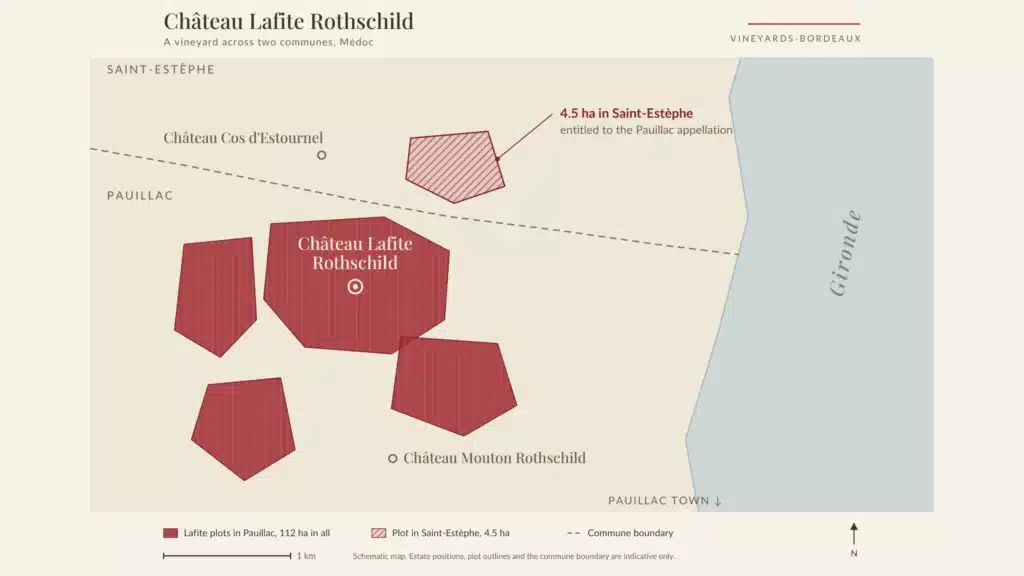
- The estate farms 112 hectares of vines. A 4.5-hectare lot sits across the commune line in Saint-Estèphe, with historical rights to the Pauillac appellation.
- Cabernet Sauvignon accounts for around 70% of plantings, Merlot for around 25%.
- Lafite’s prices rose sharply between 2005 and 2011, driven by demand from mainland China and Hong Kong. According to Liv-ex, they then fell by about 40% between February 2011 and late 2013.
- The 2024 vintage was released at €288 a bottle ex-négociant, the lowest price of any Lafite vintage on the market at the time. The 2025 came out at €336.
- Lafite is widely described as the most faked wine in the world. Provenance matters as much as vintage when buying.
Lafite in Numbers
The estate today: hectares, ownership, production
Lafite farms 112 hectares of vines in Pauillac, at the northern end of the commune. A 4.5-hectare lot sits in neighbouring Saint-Estèphe. The vineyard is planted to roughly 70% Cabernet Sauvignon and 25% Merlot, with small shares of Cabernet Franc and Petit Verdot. The exact split shifts as plots are replanted, and published figures vary by a point or two.
The estate belongs to the French branch of the Rothschild family. Baron Éric de Rothschild ran it from 1974 to 2018. His daughter Saskia de Rothschild then took over as chair. Eric Kohler has been technical director since 2016, succeeding Charles Chevallier.
The estate does not publish production figures. Trade estimates place total output across both labels somewhere between 35,000 and 40,000 cases a year, with the grand vin accounting for well under half of that in most vintages.
| Indicator | Figure |
|---|---|
| Appellation | Pauillac, Médoc |
| 1855 ranking | Premier Grand Cru Classé (First Growth) |
| Vines | 112 hectares |
| Saint-Estèphe lot | 4.5 hectares |
| Main varieties | Cabernet Sauvignon around 70%, Merlot around 25% |
| Rothschild ownership | Since 1868 |
| Second wine | Carruades de Lafite |
Where Lafite sits among the five First Growths
Lafite is one of the five First Growths named in the 1855 Classification, a ranking whose logic we unpack in a dedicated guide. The others are Latour, Margaux, Haut-Brion and Mouton Rothschild, which was promoted in 1973.
Lafite headed the 1855 list. That position still shapes how brokers, collectors and auction houses read it. It is the reference point against which the other First Growths are priced.
Four Centuries of Ownership
From the Ségur family to the Revolution
Records mention a Gombaud de Lafite holding the land as early as the 13th century. The vineyard as we know it took shape in the late 17th century, when Jacques de Ségur planted most of it around 1680.
His son, Nicolas-Alexandre, Marquis de Ségur, refined the winemaking and introduced the wine at the court of Versailles. He also owned Latour, and history remembers him as the “Prince of the Vines”. The French Revolution ended that era. Nicolas Pierre de Pichard, the last family owner, was executed in June 1794 and the estate was seized.
1868: the Rothschild acquisition and what it changed
Dutch merchants bought the estate in 1797. The Vanlerberghe family then held it through much of the 19th century. In 1868, Baron James Mayer de Rothschild bought Lafite at auction for 4.4 million francs. He died three months later.
The purchase linked Lafite to one of Europe’s best-known banking names. It gave the estate stable ownership through the century that followed, and a name that carried weight well beyond wine circles.
The 20th century: decline, the 1970s crisis, and the Éric de Rothschild revival
The early 20th century was hard. Phylloxera recovery, two world wars and the Great Depression all weighed on Bordeaux. German forces occupied Lafite during World War II and looted its cellars.
The 1960s and early 1970s produced uneven wines. The 1973 and 1974 Bordeaux market crash added financial pressure. Éric de Rothschild took over in 1974 and invested heavily. A circular underground barrel cellar designed by architect Ricardo Bofill opened in the late 1980s. Lafite regained its standing over the following decade.
The Terroir of Pauillac’s Northern Plateau
Gravel, drainage and the proximity of the Gironde
The estate describes its soils as fine, deep gravel mixed with windblown sand, over a well-drained tertiary limestone subsoil. The gravel drains quickly and stores heat. It forces vine roots to dig deep, which keeps yields low and concentration high.
The Gironde estuary lies close by. Its water mass moderates temperatures and limits spring frost risk. These conditions suit Cabernet Sauvignon, which needs a long, even ripening season.
The plot that sits in Saint-Estèphe and is still labelled Pauillac
Part of Lafite’s vineyard sits in Saint-Estèphe, across the boundary. This 4.5-hectare lot has historical rights to the Pauillac appellation. Its fruit can go into the grand vin, a rare exception in French appellation law.
Cabernet Sauvignon dominance and the blend today
The Cabernet Sauvignon share in the grand vin usually runs higher than its share of the vineyard, because the oldest and best-sited Cabernet plots feed the selection. Merlot makes up most of the remainder. The proportions move with the vintage. In 1982, the blend was 65% Cabernet Sauvignon, 29% Merlot and 6% Cabernet Franc.
What Lafite Tastes Like, and Why Critics Argue About It
The classic Lafite profile: restraint, cedar, graphite, length
Lafite is a wine of finesse more than power. Young vintages show blackcurrant, cedar, graphite and a fine, tight tannic structure. With time, notes of tobacco leaf, forest floor and dried violet emerge. The finish is long and precise.
The wine opens slowly. Great vintages often need 15 to 20 years in bottle before they show their full complexity.
The stylistic debate: elegance or dilution?
Lafite divides opinion. Its admirers praise its restraint and its ability to age. Its critics argue that some vintages lack density compared with Latour or Mouton. Others reply that this lightness of touch is the point.
In practice, the debate mostly concerns middling vintages. In great years, critics broadly agree on Lafite’s quality.
Carruades de Lafite: the second wine that became a phenomenon
Carruades de Lafite takes its name from a plateau next to the château. It comes mainly from younger vines and from lots not selected for the grand vin.
Demand for it surged during the Asian boom. In 2010, Carruades was released at €108 a bottle ex-négociant. Liv-ex reported it offered at £272.75 a bottle shortly afterward, nearly three times its release price. Few second wines have ever traded at such premiums.
The Vintages That Built the Legend
1787, 1869, 1945: the historic bottles and their auction records
In 1985, Christie’s in London sold a bottle of 1787 Lafite engraved with the initials “Th.J.” It was presented as having belonged to Thomas Jefferson. The bottle fetched about $156,000, then a record for a single bottle. Its authenticity was later challenged and remains disputed.
In October 2010, Sotheby’s Hong Kong sold three bottles of 1869 Lafite. Each fetched HK$1.8 million, about $233,000. The sale came from the château’s own cellar and became a symbol of Asian demand.
The 1945 vintage, harvested at the end of the war, is among the most celebrated of the 20th century. It appears rarely at auction and sells at very high prices.
1982: the vintage that changed everything
The 1982 vintage brought a ripeness Bordeaux had not seen for years. Some critics first predicted a short life for these generous wines. They were wrong. The 1982 Lafite has stayed youthful and gained harmony with age.
The vintage also changed the market. American collectors bought heavily, guided by new critics who praised the vintage early. The 1982 Lafite was released at 170 francs a bottle, roughly €17. Decanter has since valued it at several thousand pounds a bottle, a figure that moves with the market.
The modern reference vintages: 2000, 2003, 2008, 2010, 2016, 2018
| Vintage | Standing | Why it matters |
|---|---|---|
| 1982 | Legendary | The vintage that opened the American market |
| 2000 | Outstanding | Classic structure, the millennium benchmark |
| 2003 | Rich, atypical | Heatwave vintage, divides opinion |
| 2008 | Very good | The “number eight” bottling, central to the Asian boom |
| 2010 | Exceptional | Powerful and tense, released at the market peak |
| 2016 | Exceptional | Precise and fresh, widely bought en primeur |
| 2018 | Exceptional | Ripe and dense, long cellaring potential |
The Asian Boom and the Great Correction
2005 to 2011: how China made Lafite the most wanted wine on earth
In February 2008, Hong Kong abolished its duty on wine. The city quickly became a hub for fine wine trading and auctions. Buyers from mainland China arrived in force. They chose Lafite above all other labels.
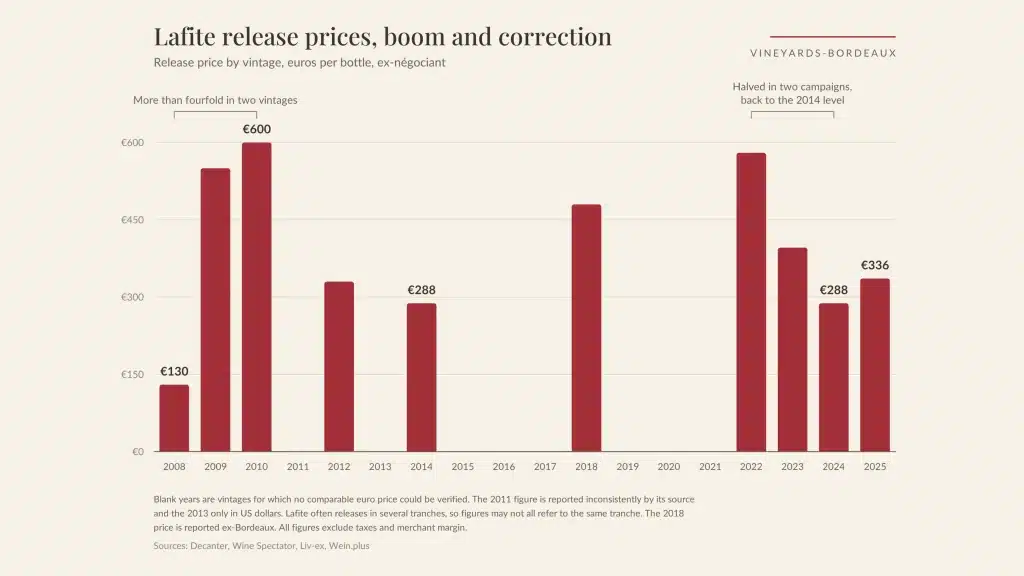
The name was easy to pronounce. It carried the prestige of 1855 and the Rothschild family. Lafite became a status symbol, a business gift and an investment vehicle. Its release prices followed. The 2009 came out at €550 ex-négociant. Decanter reported that price as 323% above the 2008 exit price and 53% above the 2005.
The 2008 vintage, the number eight, and the marketing decision that fuelled a bubble
On October 27, 2010, Lafite announced that the 2008 vintage would carry the Chinese character for eight, etched on the bottle. Eight is a lucky number in Chinese culture. The 2008 vintage also matched the year of the Beijing Olympics.
The market reacted within hours. According to Decanter, a case of Lafite 2008 rose on Liv-ex from £8,500 on the morning of October 26 to £10,160 the next day, a jump of almost 20%.
The 2011 correction and what followed
Lafite, Carruades and Duhart-Milon all peaked in February 2011. Then prices fell. According to Liv-ex, by November 2013 Lafite had lost 39.9%, Carruades just over 46% and Duhart-Milon 44%.
Several factors combined. China’s economy slowed. Then, from late 2012, an anti-corruption campaign curbed luxury gift-giving by officials. Chinese buyers also began to look beyond Lafite, toward other Bordeaux labels and Burgundy.
The wider market followed its own cycle. The Liv-ex Fine Wine 100 rose strongly from 2020 to late 2022, then fell, losing 9.1% in 2024 alone. In the first half of 2026, the index was roughly flat.
Counterfeiting: why Lafite is the world’s most faked wine
High prices and strong brand recognition made Lafite a prime target for fakes. In 2012, police in Wenzhou, China, seized nearly 10,000 bottles of suspected counterfeit Lafite. If genuine, they would have been worth up to $16 million.
At the height of the boom, trade estimates suggested that a majority of the wine sold as Lafite in China was not genuine. Those figures were estimates rather than measurements, and no reliable audit of the market exists. The scale of the problem, however, is not disputed.
Counterfeiters use refilled genuine bottles, copied labels and fake vintages. Some invent labels with names that mimic Lafite.
What Lafite Costs Today
Release prices and en primeur behaviour
Lafite sells its wine through the Bordeaux négociant system, about two years before bottling. The mechanics of buying two years ahead of bottling are explained in our guide to the Bordeaux en primeur system.
Recent releases show a clear correction, then a partial rebound.
| Vintage | Release price ex-négociant, per bottle | Change on previous vintage |
|---|---|---|
| 2009 | €550 | Reported at 323% above the 2008 exit price |
| 2010 | €600 | +9% |
| 2018 | €480 | |
| 2022 | €580 | |
| 2023 | €396 | −32% |
| 2024 | €288 | −28% |
| 2025 | €336 | +17% |
The 2024 release matched the price of the 2014. Liv-ex described it as “by far the cheapest vintage on the market”. The 2025 rose by nearly 17%, while remaining among the most affordable Lafite vintages available.
Secondary market: Liv-Ex, auction results, provenance premiums
Most Lafite trading happens on the secondary market, through merchants, auction houses and the Liv-ex trading platform. Prices depend on the vintage, the format and above all the provenance.
A case bought direct from the château or a trusted négociant, stored in a bonded warehouse and sold in its original wooden case, commands a clear premium. A bottle with an incomplete history will sell at a discount, if it sells at all.
Collectors weighing bottles against real assets may find our analysis of wine as an investment useful before committing capital.
How to buy Lafite without buying a fake
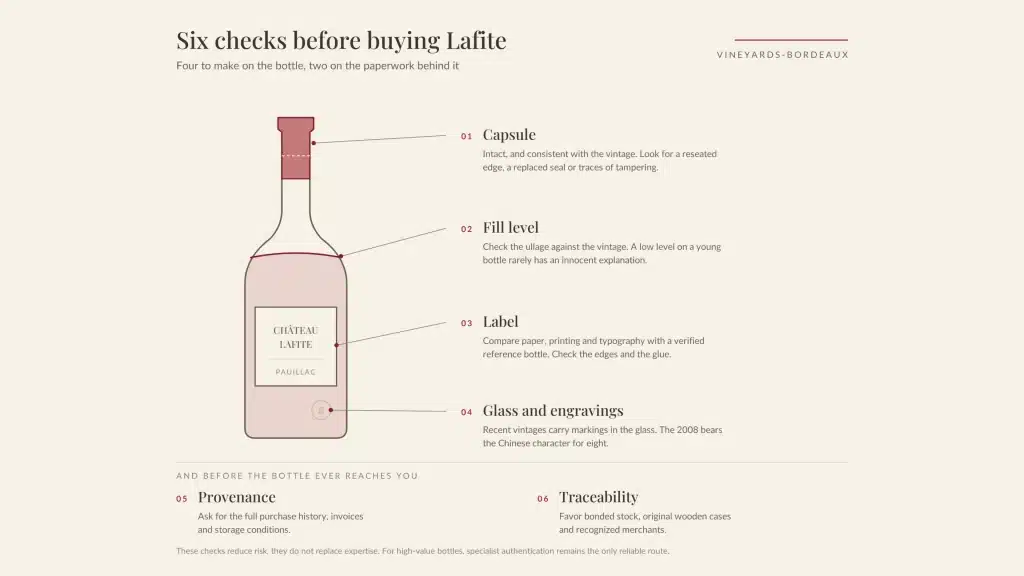
On the secondary market, check the following points before any purchase:
- Provenance: ask for the full purchase history, invoices and storage conditions.
- Fill level: check the ullage. A low level on a young vintage is a warning sign.
- Label: compare paper, printing and typography against a verified reference bottle.
- Capsule: check that it is intact and consistent with the vintage. Look for signs of tampering.
- Glass and engravings: recent vintages carry markings on the glass. The 2008 carries the Chinese character for eight.
- Traceability: favor bonded stock, original wooden cases and recognized merchants or auction houses.
The Estate as an Asset
What a Pauillac hectare is worth, and why Lafite would never sell
SAFER data reported in the trade press put the average price of a hectare of vines in Pauillac at about €1.7 million in 2025, down 32% on the previous year. That average covers a wide range of situations, from classified growths to smaller properties.
It cannot be applied to Lafite as a valuation. The brand, the stocks, the buildings and the classification carry most of the value in an estate of this rank, and none of them follow the land price. Lafite has had stable family ownership for more than 150 years, and nothing suggests a sale.
Estates of this calibre almost never come to market, though Médoc vineyard properties do change hands regularly at other levels of the hierarchy.
Domaines Barons de Rothschild: a portfolio beyond Pauillac
Lafite is the flagship of Domaines Barons de Rothschild (Lafite), often called DBR. The group began expanding in the 1960s. It owns Château Duhart-Milon in Pauillac, Château Rieussec in Sauternes and Château L’Évangile in Pomerol.
Abroad, it owns Viña Los Vascos in Chile, acquired in 1988, and Domaine d’Aussières in the Languedoc and Bodegas Caro in Argentina, both from 1999. In China, it developed a 30-hectare vineyard in Shandong province, whose first vintage was released in 2019.
The valuation logic behind such properties is set out in our methodology for appraising a wine estate.
In Brief
- Château Lafite Rothschild headed the 1855 Classification and has been owned by the Rothschild family since 1868.
- Its gravel terroir on Pauillac’s northern plateau produces a Cabernet Sauvignon–led wine known for its finesse and aging potential.
- Chinese demand pushed prices to a peak in February 2011, followed by a correction of about 40% by late 2013.
- Release prices fell 50% between the 2022 and 2024 vintages, before rising 17% with the 2025.
- On the secondary market, provenance is the main factor in both value and authenticity.
Q&A
Why is Château Lafite Rothschild so expensive?
Lafite is expensive because it combines limited production, First Growth status and global brand recognition. Its rating at the top of the 1855 Classification, its long aging potential and its history with collectors all support demand. The Asian boom of 2005 to 2011 also turned it into a speculative and status asset.
Who owns Château Lafite Rothschild?
The French branch of the Rothschild family owns Château Lafite Rothschild. Baron James Mayer de Rothschild bought it in 1868. Saskia de Rothschild has chaired the estate since 2018, succeeding her father, Baron Éric de Rothschild.
What is the difference between Lafite Rothschild and Mouton Rothschild?
They are two separate Pauillac estates owned by two different branches of the Rothschild family. They share a name and a border, and differ in almost everything else.
| Château Lafite Rothschild | Château Mouton Rothschild | |
|---|---|---|
| Rothschild branch | French branch (James de Rothschild) | English branch (Nathaniel de Rothschild) |
| Acquired | 1868 | 1853 |
| 1855 ranking | First Growth | Second Growth, promoted to First Growth in 1973 |
| Style | Restraint, finesse, cedar and graphite | Richer, more opulent and exuberant |
| Label | Classic engraving, unchanged | A different artist each year since 1945 |
What is Carruades de Lafite?
Carruades de Lafite is the second wine of Château Lafite Rothschild. It comes mainly from younger vines and lots not selected for the grand vin. The 2025 vintage was priced at about €193 a bottle including taxes.
How much does a bottle of Lafite cost?
A recent vintage of Lafite costs a few hundred euros a bottle on release. The 2024 was released at €288 ex-négociant and the 2025 at €336. Great older vintages cost far more, and the 1982 trades in the thousands of pounds a bottle.
What is the best vintage of Château Lafite Rothschild?
The 1982 is the most celebrated modern vintage of Lafite. Among historic vintages, 1945 and 1869 are the most famous. In recent decades, 2000, 2010, 2016 and 2018 are widely considered outstanding.
Can you visit Château Lafite Rothschild?
Château Lafite Rothschild is currently closed to visitors while renovation work is carried out, and the estate directs visit requests to its sister property, Château Duhart-Milon in Pauillac. Reopening dates have shifted, so confirm directly with the estate before planning a trip.
How can you tell if a bottle of Lafite is authentic?
To check a bottle of Lafite, start with its provenance and purchase history. Then examine the fill level, label, capsule and glass markings. For high-value bottles, buy only from recognized merchants or auction houses, ideally from bonded stock in original cases.
Conclusion
Lafite’s story is also the story of the modern fine wine market. Its terroir and history justify its rank. Its price curve, however, reflects collector behavior, Asian demand and the choices of the estate itself. Today, with release prices close to their lowest level in a decade, the question for buyers is less about prestige and more about provenance and timing.
The same reading applies to vineyard property. In Pauillac and across the Médoc, the value of an estate rests on its terroir, its reputation and its market position. Vineyards-Bordeaux, affiliated with Christie’s International Real Estate, supports buyers and owners in the valuation and sale of wine estates across the Bordeaux region.
Sources
- Château Lafite Rothschild, official website: lafite.com
- Decanter, “Bordeaux 2024: New Lafite is cheapest on the market” (2025)
- Decanter, “Lafite 2008 price rises 20% following Chinese symbol announcement” (October 2010)
- Decanter, “Chateau Lafite, Mouton priced at €550 to wine merchants” (2010)
- Decanter, “Bordeaux 2010: Lafite, La Mission release” (2011)
- Decanter, “Bordeaux 2018 releases: Lafite and Cheval Blanc enter campaign” (2019)
- Decanter, “Wine Legend: Château Lafite-Rothschild 1982”
- Decanter, “Fine wine prices ‘close to bottoming out’, suggests Liv-ex survey” (2025)
- The Drinks Business, “Lafite brands drop to 2010 levels” (November 2013), citing Liv-ex data
- Wein.plus, “Château Lafite Rothschild increases price by 17 percent” (2026)
- SAFER, Le prix des terres 2025, reported by Wein.plus (2026)
- WineNews, Liv-ex half-year market report (July 2026)
- Wikipedia, “Château Lafite Rothschild”
- Great Bordeaux Wines, Lafite Rothschild estate profile
- Domaines Barons de Rothschild (Lafite), producer profile
