
Estimated reading time: 13 minutes
Key takeaways
- “First Growth” (Premier Cru) names the five estates at the summit of the 1855 Classification: Lafite Rothschild, Latour, Margaux, Haut-Brion, and Mouton Rothschild.
- Four were named in 1855; Mouton Rothschild joined in 1973 — the classification’s only revision in over 170 years.
- The five span three appellations — Pauillac, Margaux, and Pessac-Léognan — each with its own gravel, clay, and limestone signature.
- On release, a bottle typically sells for $400 to over $1,000, depending on château and vintage; exceptional years fetch several times that on the secondary market.
- All five estates can be visited, but strictly by appointment, usually arranged weeks or months ahead.
Ask a wine buyer in New York, London, or Hong Kong to name five Bordeaux estates without pausing, and the list that comes back is almost always the same five, in nearly the order they have occupied since the nineteenth century. Lafite Rothschild (pronounced lah-FEET roht-SHEELD), Latour (lah-TOOR), Margaux (mar-GOH), Haut-Brion (pronounced oh-bree-OHN), and Mouton Rothschild (moo-TOHN roht-SHEELD) are Bordeaux’s First Growths — Premiers Crus — the names placed at the top of the 1855 Classification and, with a single exception 118 years later, never displaced since.
For those of us working these appellations day to day, “First Growth” describes something more concrete than a marketing term: five working estates, three appellations, and a handful of families and shareholding groups, some of whom have held the same vineyards for over a century.
- Château Lafite Rothschild — Pauillac — Domaines Barons de Rothschild (Rothschild family)
- Château Latour — Pauillac — Groupe Artémis (Pinault family)
- Château Margaux — Margaux — Mentzelopoulos family
- Château Haut-Brion — Pessac-Léognan, Graves — Domaine Clarence Dillon
- Château Mouton Rothschild — Pauillac — Rothschild family (Baron Philippe de Rothschild SA)
What follows is a working guide to what that title actually means, where it came from, what each of the five estates produces, and what it costs, on release and beyond, to bring a bottle home. And as a bonus, discover some of our vineyards for sale.
What Is a First Growth Bordeaux Wine?
In the strictest sense, a First Growth is a classification, not a flavour profile or a price point — though both tend to follow from it.
A definition rooted in the 1855 Bordeaux Classification
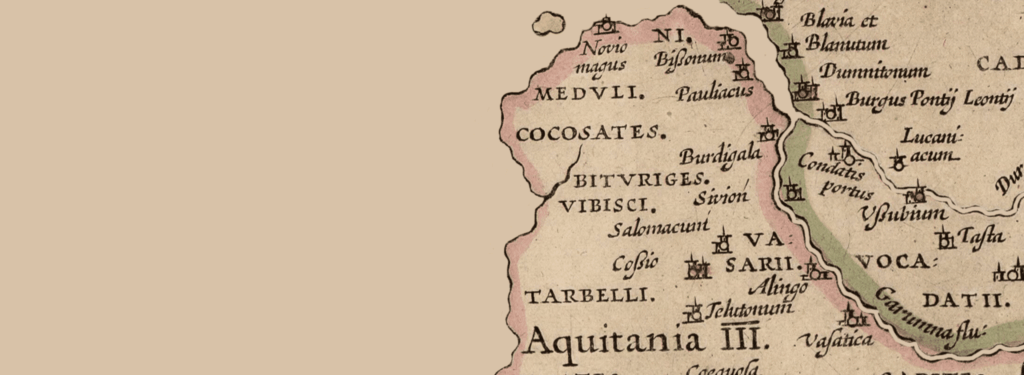
Premier Cru — First Growth in English — is the highest of five tiers in the 1855 Bordeaux Classification, a ranking of red wine estates from the Médoc, plus a single property from Graves, drawn up for Napoleon III’s Paris exhibition that year. The classification sorted 58 châteaux, later 61, into First through Fifth Growths based primarily on the prices their wines had commanded over preceding decades — a hierarchy built on the market, not a tasting panel’s verdict. Four estates were named First Growth in 1855; a fifth joined in 1973.
Why these five châteaux, and not others
The brokers who drew up the 1855 list were ranking reputation as it stood after generations of consistent pricing, and that reputation tracked terroir with remarkable accuracy. All five First Growths sit on deep gravel — in Pauillac, Margaux, or Pessac-Léognan — that drains quickly, stores daytime heat, and forces vines to root deep for water: conditions Cabernet Sauvignon rewards with concentration and structure. Other estates make wines of comparable quality today, but none has matched this group’s unbroken record since the mid-1800s.
First Growth vs Premier Grand Cru Classé: don’t confuse the two classifications
The two terms are easy to conflate: both describe a “top tier,” both use the word Cru, and both sit at the head of long lists of Bordeaux estates. But they belong to entirely different systems, on opposite banks of the Garonne.
First Growth refers exclusively to the 1855 Médoc and Graves classification, fixed since 1973 and never reviewed since. Premier Grand Cru Classé, by contrast, belongs to Saint-Émilion’s own ranking, established a century later in 1955 and revised roughly every decade — most recently in 2022, when its top “A” tier was held by Château Pavie and Château Figeac. Anyone exploring AOC Saint-Émilion vineyards on the right bank will encounter this second hierarchy, and it is worth keeping the two apart.
| First Growth (Premier Cru) | Premier Grand Cru Classé A | |
|---|---|---|
| Region | Médoc & Graves (left bank) | Saint-Émilion (right bank) |
| Established | 1855, revised once (1973) | 1955, revised roughly every decade |
| Estates currently holding the title | 5 — Lafite Rothschild, Latour, Margaux, Haut-Brion, Mouton Rothschild | 2, as of 2022 — Château Pavie, Château Figeac |
The 1855 Classification: How the First Growths Were Born
Napoleon III, the Paris Universal Exhibition, and the brokers of Bordeaux
The classification exists because of an exhibition, not a competition. In 1855, Bordeaux’s Chamber of Commerce was asked to represent the region’s wines at the Exposition Universelle in Paris, and turned to the people best placed to rank them: the city’s wine brokers, the courtiers, who knew the relative prices of these estates’ production to the franc. Working from price records stretching back decades, the brokers’ union produced its list in under two weeks, completed on 18 April 1855. Fifty-eight châteaux were sorted into five growths; Lafite Rothschild, Latour, Margaux, and Haut-Brion topped the list as First Growths — the only Graves estate among otherwise exclusively Médoc names.
One classification, one revision in 170 years: the Mouton Rothschild elevation
Mouton Rothschild was ranked a Second Growth in 1855 — a placement its owners never fully accepted. From 1922, Baron Philippe de Rothschild campaigned for its promotion, arguing that the estate’s wines had long performed at First Growth level regardless of where they sat on paper. The campaign succeeded in 1973, when a decree signed by France’s then-Minister of Agriculture, Jacques Chirac, formally elevated Mouton Rothschild to First Growth — the classification’s only amendment since 1855. The Baron marked the year with a label by Pablo Picasso, who died only months after agreeing to the commission, and adopted a motto, still associated with the estate today, built around its history of demotion and promotion: unchanged in substance, whatever its rank on paper.
From the field — Three of the five First Growths sit within a few kilometres of one another in Pauillac, yet walk their vineyards and the differences in soil depth and orientation are visible underfoot. “Pauillac” describes an appellation, not a single terroir: the gravel mounds shift from one plot to the next, sometimes within the same property — part of why three neighbouring First Growths can taste so distinct.
The Five First Growth Bordeaux Châteaux: A Profile of Each Estate
Five estates, three appellations, one ridge of gravel running through the Médoc, and a single outpost within Bordeaux’s own city limits.
Château Lafite Rothschild (Pauillac)
At the northern edge of Pauillac (pronounced pwee-YACK), bordering Mouton Rothschild, Lafite’s 112 hectares of vines are divided into three sections: the slopes around the château, the adjoining Carruades plateau, and a small parcel across the boundary in Saint-Estèphe. The deep gravel over limestone here produces a wine — roughly 70 percent Cabernet Sauvignon — that is often the most aromatically refined of the five, built on cedar, graphite, and dark fruit rather than raw power. The Rothschild family has owned Lafite since Baron James de Rothschild’s purchase at a Paris auction in 1868, and the estate is run today by his descendant Saskia de Rothschild. Its second wine, Carruades de Lafite, is itself a sought-after label.
Château Latour (Pauillac)
Latour occupies the opposite end of Pauillac, its vines running almost to the Gironde estuary. At the heart of the property sits l’Enclos, a walled plot whose fruit goes exclusively into the grand vin, its proximity to the river moderating frost risk and ripening fruit with unusual consistency. The wine — around 80 percent Cabernet Sauvignon — built its reputation on structure: dense and long-lived, made for decades rather than years. The estate takes its name, and emblem, from a stone tower still standing on the property. Since 1993 it has belonged to François Pinault’s Groupe Artémis; its second wine, Les Forts de Latour, is bottled separately and released earlier.
Château Margaux (Margaux)
South of Pauillac, in the appellation that bears its name, Margaux sits on shallower, finer gravel over limestone — soil that produces the most overtly perfumed of the five wines, prized for aromatic lift as much as power. The estate’s neoclassical château, built in the 1810s, is often considered the most architecturally striking in the Médoc, its colonnaded façade visible from the road. André Mentzelopoulos, a Greek-French businessman, bought the property in 1977; his daughter Corinne Mentzelopoulos has run it since 1980. The roughly 82-hectare vineyard, about 75 percent Cabernet Sauvignon, also produces a second wine, Pavillon Rouge, and a small amount of dry white sold under the regional Bordeaux appellation, since Margaux itself is red-only.
Château Haut-Brion (Pessac-Léognan, Graves)
Haut-Brion (oh-bree-ohn) is the outlier among the five in almost every sense. It is the only First Growth outside the Médoc, sitting in Pessac-Léognan within Bordeaux’s southern urban fringe, its vineyards bordered by roads and housing rather than open countryside. It is also the oldest: written references to the estate’s wine date back to the 1660s, making it the first Bordeaux property known by name to English drinkers. Its blend leans further toward Merlot than its Médoc counterparts — roughly 45 percent Cabernet Sauvignon and 37 percent Merlot — giving a wine built on earth, tobacco, and savoury depth rather than pure Cabernet structure. The estate has belonged to the Dillon family’s Domaine Clarence Dillon since 1935, led today by Prince Robert of Luxembourg, and produces a tiny, highly sought white wine alongside its red.
Château Mouton Rothschild (Pauillac)
Mouton (moo-TOHN) sits on its own gravel rise, the Plateau de Mouton, immediately north of Lafite. Acquired by Nathaniel de Rothschild in 1853, it was Baron Philippe de Rothschild who, from 1922, transformed both the estate’s winemaking — pioneering château-bottling — and its public image, most visibly through a tradition begun in 1945: commissioning a different artist’s label every vintage, among them Dalí, Chagall, Miró, Warhol, and, in 1973, Picasso. The roughly 90-hectare vineyard, around 81 percent Cabernet Sauvignon, produces a powerful, structured wine. Since Baroness Philippine de Rothschild’s death in 2014, the estate has been run by her three children, who also oversee its wine-and-art museum.
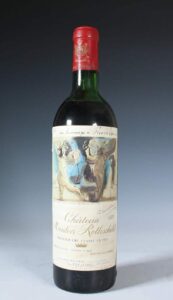
Château Mouton Rothschild First Grand Cru Classified Growth Pauillac Bordeaux, In Homage to Picasso, 1973
The Five First Growths at a Glance
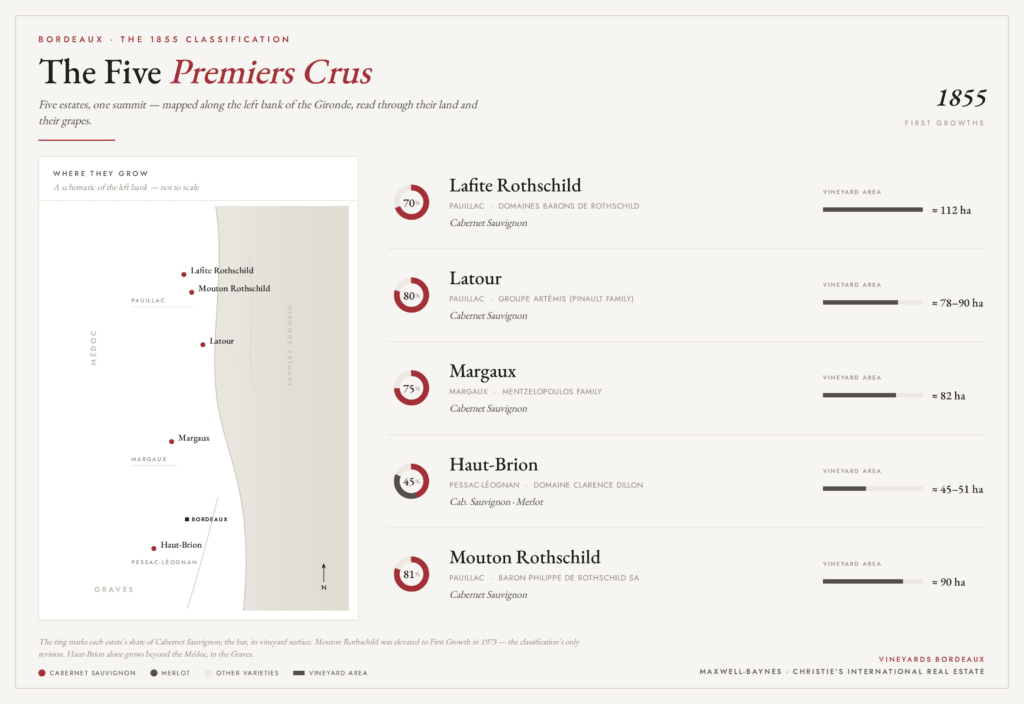
Set side by side, the differences in scale, ownership, and grape mix are easier to read at a glance — useful context before tasting, buying, or simply talking about any of the five.
| Château | Appellation | Owner | Vineyard area | Dominant grape |
|---|---|---|---|---|
| Lafite Rothschild | Pauillac | Domaines Barons de Rothschild | ~112 ha | Cabernet Sauvignon (~70%) |
| Latour | Pauillac | Groupe Artémis (Pinault family) | ~78–90 ha | Cabernet Sauvignon (~80%) |
| Margaux | Margaux | Mentzelopoulos family | ~82 ha | Cabernet Sauvignon (~75%) |
| Haut-Brion | Pessac-Léognan | Domaine Clarence Dillon | ~45–51 ha | Cabernet Sauvignon / Merlot (~45% / 37%) |
| Mouton Rothschild | Pauillac | Rothschild family (Baron Philippe de Rothschild SA) | ~90 ha | Cabernet Sauvignon (~81%) |
Understanding the Style of First Growth Bordeaux Wines
Why Cabernet Sauvignon defines four of the five
Cabernet Sauvignon ripens late and needs warmth held in the soil after sunset, exactly what the deep gravel beds of AOC Médoc vineyards provide, acting as a heat reservoir through the growing season. Four of the five First Growths sit on this gravel and lean heavily on the variety, producing wines structured around firm tannin, blackcurrant, cedar, and graphite. Haut-Brion’s terroir, with more clay mixed into its gravel, ripens Merlot just as successfully, which is why its blend, and its flavour profile, sits apart from its Pauillac and Margaux counterparts.
Ageing potential, vintage variation and when to drink them
These wines are built to outlive the people who buy them on release. Top vintages routinely improve for 20 to 30 years and can remain vital well past 50, though most are approachable — if still youthful — within a decade. Vintage variation matters more here than for almost any other wine: a cool, wet year and a long, even growing season can produce noticeably different wines from the same estate, and prices on the secondary market track this closely. 2000, 2005, 2009, 2010, 2016, and 2019 are widely regarded among the strongest recent vintages across all five châteaux.
How Much Does a First Growth Bordeaux Cost?
Release prices, secondary market and the Liv-Ex effect
Most First Growth wine first reaches buyers through en primeur (pronounced ahn pree-MUR) — sold roughly eighteen months before bottling, while still ageing in barrel. Release prices vary by château and, more importantly, by vintage: a lighter year might open around $400–600 a bottle, while a vintage with strong early reviews can open well above $1,000. Bordeaux’s en primeur system rewards anticipation as much as patience, and the pricing decisions made each spring set the tone for how a vintage trades for decades afterward.
Once bottled, these wines move onto the secondary market, where the Liv-ex Fine Wine 50 — a daily index tracking the ten most recent vintages of the five First Growths — serves as the closest thing fine wine has to a stock ticker. That index has spent much of the past three years in decline alongside the broader fine wine market, though 2025 brought the first signs of stabilisation.
Editor’s note — The en primeur campaign each spring draws négociants, critics, and buyers to Bordeaux for a few intense weeks of barrel tastings, long before these wines have taken their final shape. Locally, it’s treated less as a sales event than as an annual checkpoint on the vintage — a chance to taste a wine’s raw material and form an early view, well before the label, or the price, is finalised.
Roughly, pricing tends to break down as follows:
- Recent vintage, lighter year: roughly $400–600 per bottle on release.
- Recent vintage, highly rated year: roughly $700–1,200 or more on release.
- “Legendary” vintages, such as 2000, 2009, or 2010: often $1,500–5,000 or more on the secondary market.
- Rare older vintages at auction: exceptional bottles and large formats can reach tens of thousands of dollars.
Are First Growths a sound investment?
First Growths sit at the core of most fine wine portfolios for reasons beyond prestige: long trading histories, daily index pricing, and a market of collectors and merchants deep enough to allow trading at scale. Over multi-decade periods, this group has delivered solid appreciation — but the past three years are a reminder that the market is cyclical, not a one-way escalator, and that illiquidity, storage costs, and provenance all affect realised returns. For anyone wondering how to invest in a vineyard, or why and how to invest in wine, the same questions of horizon, liquidity, and storage apply.
From the field — Whatever the secondary market does in any given year, the estates themselves change hands extraordinarily rarely. Lafite has had one owner since 1868, Mouton since 1853, Haut-Brion’s current family since 1935. When a property anywhere near this tier does come to market, it tends, in our experience, to attract attention disproportionate to its size — a measure of how tightly held this small group remains.
Visiting the First Growth Châteaux: What You Need to Know
Access policies: by appointment only, mostly closed to the general public
None of the five First Growths receive walk-in visitors. Tastings and tours are by appointment only, booked directly through the estate or via specialist agencies, and at the most sought-after properties, Latour and Lafite in particular, slots can fill months ahead, especially for spring and autumn dates. Mouton Rothschild’s wine-and-art museum operates on a somewhat more accessible schedule than its cellars, but still requires advance booking. Planning well ahead of travel dates is simply part of the experience, as well as deciding which vineyard to visit around Bordeaux.
When to plan a visit and where to base yourself
Spring (April to June) and early autumn (September to October) offer the most reliable weather and the least disruption to estate operations, though visiting during harvest has its own appeal for anyone curious about how these wines are actually made. Haut-Brion, inside Bordeaux’s city limits, can be reached on a half-day from the centre; the Pauillac and Margaux estates are roughly forty-five minutes by car, and basing a stay in one of these villages makes it easier to combine a First Growth visit with other vineyards worth visiting around Bordeaux.
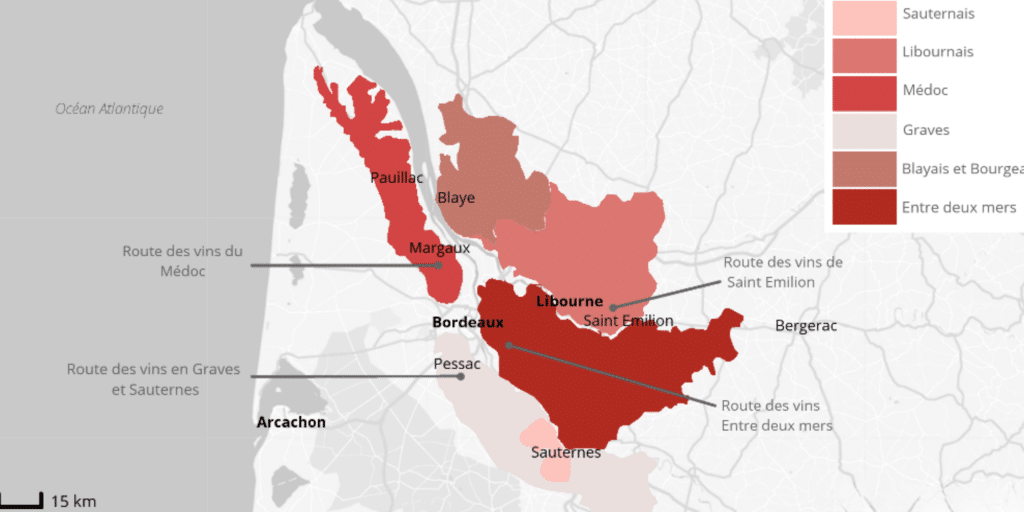
A map of the Five First Growths
Frequently Asked Questions
About First Growth Bordeaux
Five. Four were classified First Growth in 1855, and a fifth, Château Mouton Rothschild, joined in 1973.
The five First Growths, with their appellations, are:
– Château Lafite Rothschild — Pauillac
– Château Latour — Pauillac
– Château Margaux — Margaux
– Château Haut-Brion — Pessac-Léognan, Graves
– Château Mouton Rothschild — Pauillac
First Growth (Premier Cru) belongs to the 1855 Médoc and Graves classification and applies to five estates, fixed since 1973. Premier Grand Cru Classé A belongs to a separate, later classification specific to Saint-Émilion, revised roughly every decade, with different estates currently holding the title.
In 1973, by ministerial decree — the only revision to the 1855 Classification, after half a century of lobbying by Baron Philippe de Rothschild.
No. Pétrus is in Pomerol, on Bordeaux’s right bank, an appellation with no official classification of its own. Its prices and reputation — often rivalling or exceeding the First Growths — rest entirely on market demand rather than any formal ranking.
Typically $400 to $1,000 or more, depending on the château and the vintage’s reputation at release. Exceptional vintages can open well above that range and rise further on the secondary market.
Decades, in the right vintages. Many First Growths from great years remain excellent at 30 to 50 years old, and some considerably longer, though most are enjoyable well before that.
Yes, but only by appointment — there is no public access without a reservation, and booking well ahead is strongly advised.
The 1855 Classification was drawn up to settle a question of pricing for a nineteenth-century exhibition, and yet its five First Growths remain, with one exception, exactly where they were placed 170 years ago. For anyone exploring Bordeaux’s vineyards for sale, from working estates to smaller parcels in the appellations surrounding these five names, understanding how to value a wine estate is the natural next step.
