

Bordeaux divides along its rivers. The Left Bank lies west of the Garonne and the Gironde estuary, the Right Bank north of the Dordogne. Each bank has its own soils, its dominant grape, its classification logic and its land market. This guide compares them in the glass, on the label and per hectare.
In Brief
- Left Bank: Médoc, Graves, Pessac-Léognan, Sauternes. Gravel soils, Cabernet Sauvignon in the lead, the 1855 and Graves classifications.
- Right Bank: Saint-Émilion, Pomerol, Fronsac, Castillon, Blaye, Bourg. Clay and limestone soils, Merlot in the lead, a classification revised every ten years (Saint-Émilion) or none at all (Pomerol).
- Land prices (Safer, 2025): from about 10,000 € per hectare in the Médoc to 1.7 million € in Pauillac. Pomerol has no published average, and its best parcels are estimated near 5 million €.
- Entre-Deux-Mers sits between the Garonne and the Dordogne and belongs to neither bank.
Where the Left Bank Ends and the Right Bank Begins
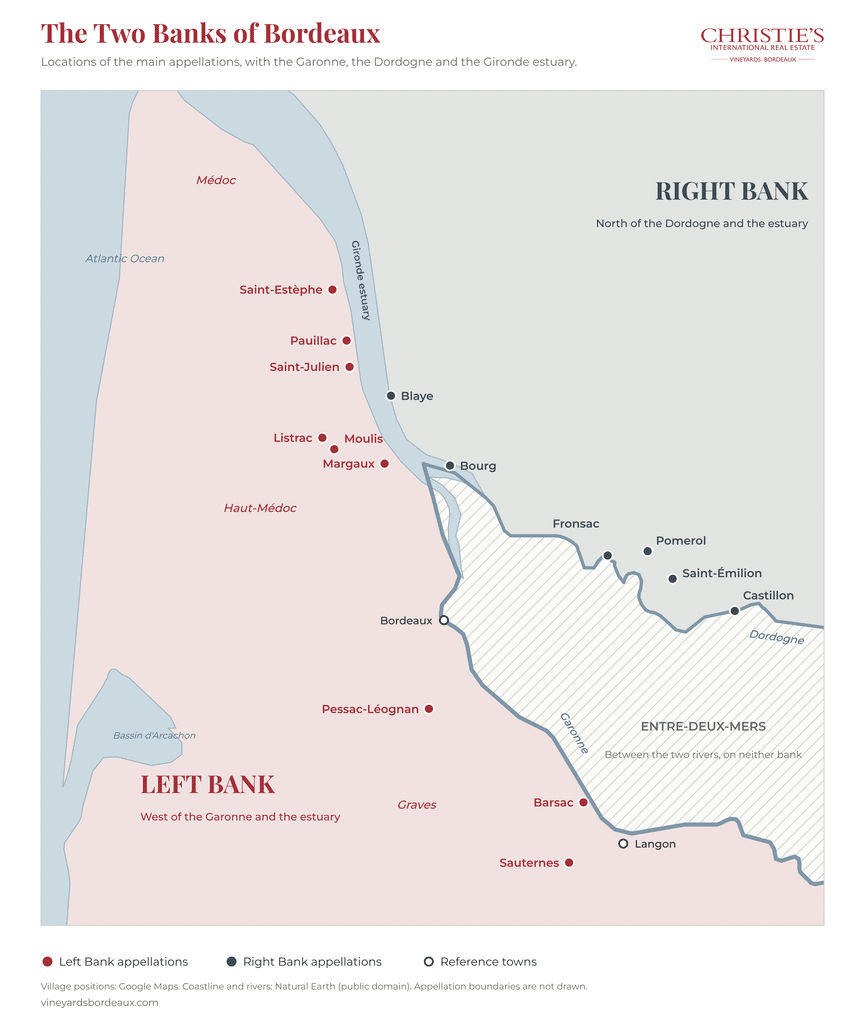
The Left Bank covers the vineyards west of the Garonne and the Gironde estuary: the Médoc and Haut-Médoc, the communal appellations of Saint-Estèphe, Pauillac, Saint-Julien and Margaux, then Graves, Pessac-Léognan, Sauternes and Barsac. The Right Bank covers Saint-Émilion, Pomerol, Fronsac, Castillon, Blaye and Bourg, north of the Dordogne.
The Garonne, the Dordogne and the Gironde estuary
Two rivers rise in different parts of France and meet north of Bordeaux. The Garonne flows through the city, the Dordogne arrives from the east, and they join at the Bec d’Ambès to form the Gironde estuary. Everything on the west side of the Garonne and the estuary is Left Bank. Everything on the north and east side of the Dordogne and the estuary is Right Bank. The terms describe a position on the map, as a sailor would see it going downstream.
Which appellations belong to each bank
North of the city, the Left Bank’s heartland is the Médoc and its eight appellations, from Saint-Estèphe to Margaux, with Listrac and Moulis inland. South of the city, the gravel continues into Graves, then Sauternes and Barsac for sweet white wines.
On the Right Bank, Saint-Émilion and its satellites (Montagne, Lussac, Puisseguin, Saint-Georges) face Pomerol and Lalande-de-Pomerol. Fronsac and Castillon extend the bank to the east and west, while Blaye and Bourg follow the estuary.
What about Entre-Deux-Mers?
The name means “Entre-Deux-Mers” which here means between two tidal rivers. This large area lies between the Garonne and the Dordogne, so it fits neither bank in the strict sense. It produces mostly Bordeaux and Bordeaux Supérieur reds and the dry whites of the Entre-Deux-Mers appellation.
Soils and Grapes: Why the Two Banks Taste Different
Soil explains most of the divide. The Left Bank sits on gravel terraces, the Right Bank on clay and limestone. Growers chose their grapes to match.
Gravel and Cabernet Sauvignon on the Left Bank
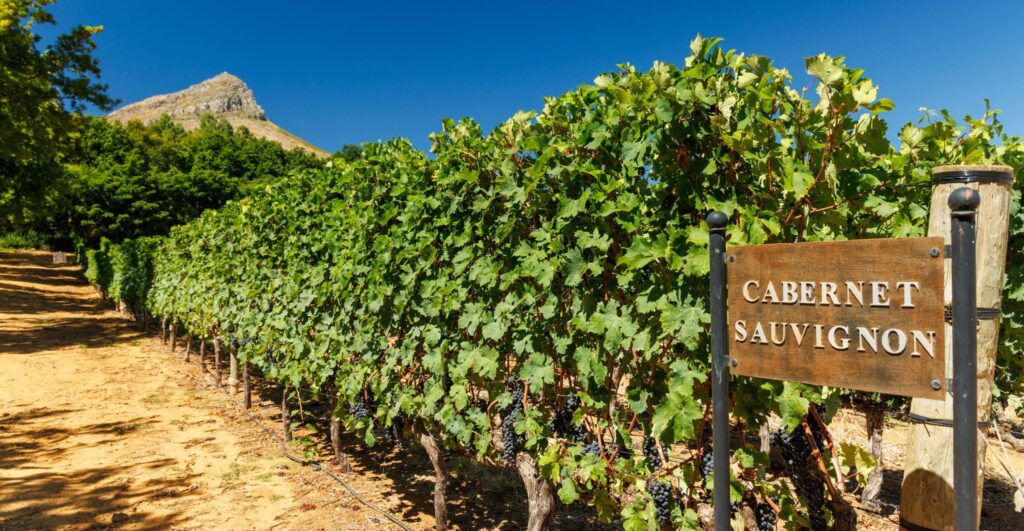
Gravel drains fast and holds heat. Cabernet Sauvignon ripens late, so it needs warm, well-drained ground to reach full maturity. The Médoc and Graves offer exactly that, and Cabernet Sauvignon leads the blends there, supported by Merlot, Cabernet Franc and Petit Verdot. The Bordeaux Supérieur specifications and Kees van Leeuwen’s 2018 research in OENO One tie each soil type to its grape in the same way.
Clay, limestone and Merlot on the Right Bank
Clay holds water through dry summers, and limestone adds freshness. Merlot ripens earlier and thrives on these cooler, moister soils. It leads the blends in Saint-Émilion and Pomerol, with Cabernet Franc as the usual partner. In Pomerol, a band of iron-rich clay gives the appellation its particular structure.
How the wines compare in the glass
Left Bank wines tend to show firm tannins, dark fruit, cedar and graphite notes, and a long, structured finish. They often reward cellaring. Right Bank wines tend to feel rounder and softer, with plum, black cherry and spice, and they often drink well earlier. These are tendencies, and the line blurs easily. Both banks blend several grapes, and the proportions vary widely from one estate to the next. A Pauillac with generous Merlot and a Saint-Émilion built on Cabernet Franc will each sit away from the stereotype.
Left Bank vs Right Bank Bordeaux at a glance
| Main appellations | Dominant soils | Dominant grape | Classification | Price per hectare (Safer, 2025) | |
|---|---|---|---|---|---|
| Left Bank | Médoc, Haut-Médoc, Saint-Estèphe, Pauillac, Saint-Julien, Margaux, Listrac, Moulis, Graves, Pessac-Léognan, Sauternes, Barsac | Alluvial gravels | Cabernet Sauvignon, blended with Merlot, Petit Verdot and Cabernet Franc | 1855 classification (Médoc, Château Haut-Brion, Sauternes, Barsac). Graves classification (1953, revised 1959) | From €10,000 (Médoc) to €1.7 million (Pauillac) |
| Right Bank | Saint-Émilion and satellites, Pomerol, Lalande-de-Pomerol, Fronsac, Castillon, Blaye, Bourg | Limestone plateau and clay slopes in Saint-Émilion. Clay substrate under gravels, with iron oxides, in Pomerol | Merlot, blended with Cabernet Franc (Pomerol: Merlot very largely dominant) | Saint-Émilion: classification in place since 1955, revisable every ten years (latest edition 2022). Pomerol: none | From €10,000 (Lussac) to about €200,000 (Saint-Émilion average). Pomerol: no published average |
Sources: INAO, Ministère de l’Agriculture (AOC Pomerol), Decanter, Fine+Rare, van Leeuwen (OENO One, 2018). Prices: Safer 2025 averages reported by Jane Anson with Knight Frank analysis (July 2026).
Two Very Different Classification Systems
A label tells you which system the estate belongs to, so it helps to know the three that matter.
The 1855 classification and the Graves classification
The 1855 classification ranked the red wines of the Médoc, plus Château Haut-Brion in Graves, from First to Fifth Growth. It also ranked the sweet wines of Sauternes and Barsac. It has stayed almost unchanged for 170 years. Graves created its own list in 1953 and revised it in 1959. South of Bordeaux, Pessac-Léognan is an appellation as strong in white as in red, and its classified estates come from that Graves system.
Saint-Émilion: a classification revised every ten years
Saint-Émilion works differently, with a classification that can promote and demote estates. Created in 1955, it is revised roughly every ten years. The 2022 edition names Figeac and Pavie as the two Premiers Grands Crus Classés A. Ausone, Cheval Blanc and Angélus withdrew from the process, as did La Gaffelière, a Premier Grand Cru Classé B. The tiers now count 2 estates at A, 12 at B and 71 Grands Crus Classés.
Pomerol: no classification at all
Its neighbor has never needed a ranking, as our guide to Pomerol and its estates explains. Pétrus, Le Pin and Lafleur built their reputations without a tier. For a buyer, this means the market sets the hierarchy.
Which Is More Expensive, Left Bank or Right Bank?
Neither bank holds a monopoly on high prices. The answer depends on whether you mean a bottle or a hectare.
In the bottle: where the most expensive wines come from
Both banks produce Bordeaux’s most sought-after bottles. The Left Bank has the First Growths of Pauillac, Margaux and Graves. The Right Bank has Pétrus, Cheval Blanc and Ausone. Bottle prices change with each vintage and each month, so we quote none here. Liv-ex publishes dated figures for readers who want current numbers.
In the vineyard: what a hectare costs on each bank in 2025
Land tells a clearer story. The table below uses 2025 averages from the Safer, as reported in July 2026 by Jane Anson with analysis from Knight Frank.
| Appellation | Bank | Average price per hectare, 2025 |
|---|---|---|
| Pauillac | Left | 1,700,000 € (2,500,000 € in 2024) |
| Margaux | Left | 800,000 € |
| Pessac-Léognan | Left | 400,000 € |
| Saint-Estèphe | Left | 300,000 € |
| Haut-Médoc | Left | 30,000 € |
| Médoc | Left | 10,000 € |
| Saint-Émilion | Right | About 200,000 € (very wide spread) |
| Lalande-de-Pomerol | Right | 130,000 € |
| Montagne | Right | 50,000 € |
| Lussac | Right | 10,000 € |
| Pomerol | Right | No published average |
Three points shape how to read these figures. First, Pauillac fell from 2.5 million € in 2024, and Margaux dropped below 1 million € for the first time since 2007. Second, Pomerol had too few transactions to produce an average. Its finest parcels are estimated near 5 million € per hectare, though 2025 offered no sale to confirm it. Third, Saint-Émilion’s average hides a very large gap between a village plot and a Premier Grand Cru Classé hillside.
At the top end, the Left Bank commands the highest published averages. At the entry level, both banks offer land at 10,000 € per hectare. The spread inside each bank often matters more than the difference between them.
Buying Property on Either Bank
Two markets under different pressures
Both banks have felt the downturn in Bordeaux demand, and they have felt it differently. Knight Frank’s analysis, published in July 2026, expects the wealthier classified estates of the Left Bank to weather the current conditions better. On the Right Bank, several Grands Crus Classés in Saint-Émilion have found no buyer. Knight Frank also calls the sale of Château La Couspaude a one-off, not a sign of recovery. This is an adviser’s reading of a market with few transactions.
Which bank to buy on: the questions that matter
No bank is better in the abstract. These questions point toward the right one for a given owner:
- Which style do you want to produce, firm and structured or round and early-drinking?
- What scale suits you? Left Bank estates tend to be larger, Right Bank estates smaller.
- Do you want a classified name, an unclassified one, or the freedom of an appellation without a ranking?
- How do you plan to sell your wine, through the Bordeaux négociant system, directly, or both?
- What holding period do you expect, given how thin the transaction record is in some appellations?
Prices span a wide range on both banks, and Médoc estates currently on the market cover both ends of it.
In Brief: Left Bank vs Right Bank
Geography sets the line: the Garonne and the estuary on the west, the Dordogne on the north. Gravel and Cabernet Sauvignon define the Left Bank, clay, limestone and Merlot the Right. The Left Bank follows the 1855 and Graves classifications, Saint-Émilion revises its own every ten years, and Pomerol keeps none. In 2025, land ran from 10,000 € to 1.7 million € per hectare, with both banks under pressure.
Common Questions
What is the Left Bank in Bordeaux?
The Left Bank is the group of Bordeaux vineyards west of the Garonne and the Gironde estuary. It includes the Médoc, Haut-Médoc, Graves, Pessac-Léognan, Sauternes and Barsac. Its gravel soils favor Cabernet Sauvignon, and its best estates appear in the 1855 and Graves classifications.
Which wines are Left Bank Bordeaux?
Wines from Saint-Estèphe, Pauillac, Saint-Julien, Margaux, Listrac, Moulis, Haut-Médoc, Médoc, Graves and Pessac-Léognan are Left Bank reds, while Sauternes and Barsac are Left Bank sweet whites. Most are Cabernet Sauvignon blends.
Is Saint-Émilion Left Bank or Right Bank?
Saint-Émilion is on the Right Bank. It lies north of the Dordogne, on limestone plateaus and clay slopes. Merlot leads its blends, with Cabernet Franc in support.
Is Pomerol Left Bank or Right Bank?
Pomerol is on the Right Bank, next to Saint-Émilion. It has no official classification, and its wines are mostly Merlot on clay.
Is Pessac-Léognan on the Left Bank?
Pessac-Léognan is on the Left Bank. It lies south of the city of Bordeaux, on the west side of the Garonne, and belongs to the Graves area. It makes both red and white wines.
Is Left Bank or Right Bank Bordeaux better?
Neither bank is better. The Left Bank suits readers who prefer firm tannins and long cellaring, the Right Bank those who prefer a rounder, earlier-drinking style. Quality depends on the estate, the vintage and the producer, not on the side of the river.
Is Left Bank or Right Bank Bordeaux more expensive?
Land costs more at the top of the Left Bank. In 2025, Pauillac averaged 1.7 million € per hectare, against about 200,000 € in Saint-Émilion. Pomerol’s best parcels are estimated near 5 million €, so the highest values appear on both banks. Bottle prices depend on the estate and vintage.
Conclusion
The two banks offer two ways into Bordeaux, one built on gravel and Cabernet, the other on clay and Merlot. They also offer two property markets, with prices and pressures of their own. A walk through both is the best way to see the difference. Our team in Saint-Émilion is glad to share what it sees on the ground.
Sources
- Jane Anson, Bordeaux vineyard prices: everyone impacted (Safer 2025 prices and Knight Frank analysis, July 2026)
- Decanter, St-Émilion 2022 classification promotes Château Figeac to Premier Grand Cru Classé A
- Ministère de l’Agriculture, Cahier des charges AOC Bordeaux supérieur
- van Leeuwen et al., OENO One, 2018