
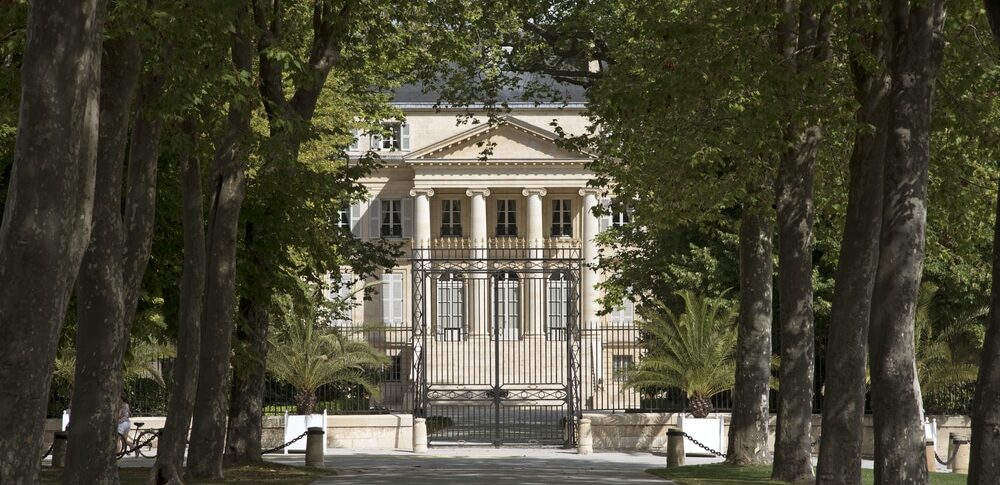
Few names in wine carry the weight of Médoc. This narrow peninsula on Bordeaux’s Left Bank produced four of the five First Growths and gave the world its most studied classification, the 1855 ranking. Yet the region itself is often misunderstood. Médoc is not one appellation but eight, layered across a landscape shaped by gravel, water and centuries of winemaking discipline. This guide sets out that architecture clearly, from the geography that defines each appellation to the styles, vintages and estates that make the Médoc a reference point for collectors and buyers worldwide.
In Brief
- The Médoc is a peninsula on Bordeaux’s Left Bank, structured around two regional appellations (Médoc, Haut-Médoc) and six communal appellations.
- Cabernet Sauvignon dominates the blend across most of the region, supported by Merlot, Cabernet Franc and Petit Verdot.
- Four of the five First Growths from the 1855 Classification sit within the Médoc: Lafite Rothschild, Latour, Margaux and Mouton Rothschild.
- Pauillac, Saint-Julien, Saint-Estèphe and Margaux form the historic core of communal appellations, each with a distinct style.
- Modern vintages from 2000 onward have confirmed the Médoc’s capacity for both power and freshness.
What Is Médoc Wine? A Definition
Médoc wine refers to red wine produced on the Left Bank of the Gironde estuary, north of the city of Bordeaux. The term covers a strict geographic and administrative area governed by its own appellation rules, distinct from the Right Bank appellations of Saint-Émilion and Pomerol. The vineyards of Bordeaux at a glance offers a useful starting point for readers who want to situate the Médoc within the wider Bordeaux vineyard before exploring its internal structure.
A peninsula on the Left Bank of the Gironde
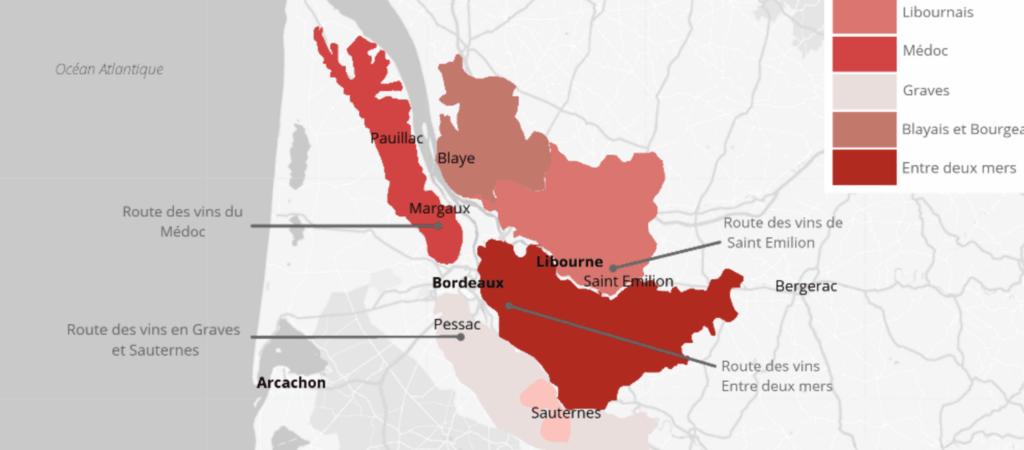
The Médoc occupies a narrow strip of land bordered by the Atlantic Ocean to the west and the Gironde estuary to the east. This double influence moderates temperatures and protects the vines from extreme frost, a factor that has shaped viticulture here since the seventeenth century. The peninsula stretches roughly 80 kilometers north of Bordeaux, from the city’s outer edge to the Pointe de Grave.
Two regional and six communal appellations
The Médoc is organized into eight appellations. Two are regional: Médoc and Haut-Médoc, covering the broadest area. Six are communal, each tied to a specific set of villages: Saint-Estèphe, Pauillac, Saint-Julien, Listrac-Médoc, Moulis-en-Médoc and Margaux. Communal appellations sit within the boundaries of Haut-Médoc but carry stricter production rules and, in most cases, greater prestige. Understanding this nesting structure is the key to reading any Médoc wine label correctly.
The Geography and Terroir of the Médoc
Gravel soils shaped by the Gironde
The defining feature of Médoc terroir is gravel. Deposited over millennia by the Gironde and its tributaries, these gravel mounds, known locally as croupes, drain quickly and retain heat, both essential for ripening Cabernet Sauvignon. The deepest and most prized gravel beds run along the estuary, which explains why the most celebrated châteaux cluster close to the water.
A maritime climate moderated by the estuary
The Médoc benefits from an oceanic climate softened by the Gironde. The estuary acts as a thermal regulator, reducing frost risk in spring and extending the ripening season into autumn. Rainfall is distributed across the year, and the proximity to the Atlantic brings a near-constant breeze that helps keep the vineyards healthy.
Bas-Médoc vs Haut-Médoc: understanding the split
The region divides naturally into two zones. Bas-Médoc, the northern half, corresponds to the regional Médoc appellation and produces wines with a more rustic character. Haut-Médoc, to the south, contains the finest gravel terroirs and nearly all six communal appellations. Despite its name, Haut-Médoc refers to elevation on the map rather than altitude: the terrain itself remains largely flat.
The Grape Varieties of the Médoc
Cabernet Sauvignon: the dominant grape
Cabernet Sauvignon thrives on the warm, well-drained gravel of the Médoc and forms the backbone of most classified blends. It typically represents 60 to 65 percent of the assemblage in top estates, contributing structure, tannin and the region’s signature blackcurrant character.
Merlot, Cabernet Franc, Petit Verdot: the supporting cast
Merlot generally accounts for 25 to 30 percent of the blend, softening the wine and adding fruit density, particularly on the clay-influenced plots. Cabernet Franc and Petit Verdot play smaller roles, usually a few percentage points each, lending aromatic lift and color. A handful of estates retain small plantings of Malbec or Carménère, largely for historical reasons.
Typical share of each grape variety in a classified Médoc blend:
- Cabernet Sauvignon: approximately 60-65%
- Merlot: approximately 25-30%
- Cabernet Franc: approximately 5%
- Petit Verdot: approximately 1-3%
- Malbec and Carménère: marginal, largely historical plantings
The Appellations of the Médoc: A Complete Overview
Beyond the eight appellations themselves, the Médoc is home to some of Bordeaux’s most storied estates. Bordeaux wine estates: an insider’s guide traces the properties that anchor the region’s reputation, many of which sit within the communal appellations described below.
Médoc AOC (regional)
The Médoc appellation, sometimes called Bas-Médoc, covers the northern half of the peninsula. Its wines tend to be approachable and fruit-forward, with a higher share of Merlot than the communal appellations further south. For buyers exploring ownership in the region, AOC Médoc vineyards for sale presents current opportunities to acquire vineyard property within this appellation.
Haut-Médoc AOC (regional)
Haut-Médoc stretches across the southern two-thirds of the peninsula and contains the six communal appellations within its boundaries. Estates classified simply as Haut-Médoc, outside the communal zones, produce wines of real structure at generally more accessible prices than their communal neighbors.
Saint-Estèphe: power and structure
The northernmost of the communal appellations, Saint-Estèphe sits on heavier, clay-influenced soils than its neighbors. This gives its wines a firm tannic backbone and notable longevity. Château Cos d’Estournel and Château Montrose anchor the appellation’s reputation for wines built to age.
Pauillac: home to three of the five First Growths
Pauillac is widely regarded as the spiritual capital of the Médoc. Its gravel terroir produces concentrated, cassis-driven wines with remarkable aging potential. Three of the five First Growths, Lafite Rothschild, Latour and Mouton Rothschild, are located here, alongside eighteen classified growths in total.
Saint-Julien: the perfect middle ground
Situated between Pauillac and Margaux, Saint-Julien is the smallest of the communal appellations but consistently produces wines of exceptional balance. Its style bridges the power of Pauillac and the elegance of Margaux, a reputation reflected in the density of classified estates within its compact boundaries.
Listrac-Médoc and Moulis-en-Médoc: hidden gems
These two appellations, tucked inland from the estuary, hold no classified growths from 1855 but offer genuine value. Listrac-Médoc produces firm, structured wines on clay-limestone soils, while Moulis-en-Médoc, the smallest appellation in the Médoc, yields robust reds from gravel outcrops similar to those of its more famous neighbors.
Margaux: elegance and floral aromatics
Margaux is the largest and southernmost communal appellation, spanning five villages. Its lighter gravel and greater soil diversity produce wines known for perfume, silkiness and floral aromatics, a style epitomized by Château Margaux itself, one of the region’s four First Growths.
The Eight Appellations of the Médoc at a Glance
| Appellation | Surface planted (approx.) | Dominant grape | Dominant style |
|---|---|---|---|
| Médoc (regional) | ~5,700 ha | Cabernet Sauvignon / Merlot | Approachable, fruit-forward |
| Haut-Médoc (regional) | ~4,600 ha | Cabernet Sauvignon | Structured, variable by terroir |
| Saint-Estèphe | ~1,280 ha (8% of the Médoc vineyard) | Cabernet Sauvignon | Powerful, tannic, age-worthy |
| Pauillac | 1,200 ha (8% of the Médoc vineyard) | Cabernet Sauvignon | Concentrated, cassis, cedar |
| Saint-Julien | 910 ha (6% of the Médoc vineyard) | Cabernet Sauvignon | Balanced, refined |
| Margaux | 1,490 ha (red wine) | Cabernet Sauvignon | Perfumed, silky, floral |
| Listrac-Médoc | 787 ha | Cabernet Sauvignon / Merlot | Firm, structured |
| Moulis-en-Médoc | 610 ha | Cabernet Sauvignon | Robust, gravel-driven |
Figures for Saint-Estèphe, Pauillac, Saint-Julien, Margaux, Listrac-Médoc and Moulis-en-Médoc are drawn from CNES GeoImage’s geographic analysis of the Médoc, based on INAO appellation specifications and Agreste data. Figures for the two regional appellations, Médoc and Haut-Médoc, remain cross-referenced estimates and should be treated as approximate.
The 1855 Classification and the Grands Crus Classés
How the 1855 Classification shaped the Médoc
Commissioned by Napoleon III for the Exposition Universelle de Paris, the 1855 Classification ranked the top red wines of the Médoc, along with one estate from Graves, Château Haut-Brion. The ranking was based on the price each wine commanded at the time, a proxy for reputation and quality. For more than a century and a half, it has remained the reference framework for the region’s finest properties, with only one change: Château Mouton Rothschild’s promotion to First Growth in 1973. First Growth Bordeaux: the complete guide covers these five estates and their place at the summit of the classification in detail.
The five categories of Grands Crus Classés
Sixty Médoc estates were classified in 1855, distributed across five tiers from First to Fifth Growth.
| Category | Number of châteaux in the Médoc | Notable examples |
|---|---|---|
| First Growths (Premiers Crus) | 4 | Château Lafite Rothschild, Château Latour, Château Margaux, Château Mouton Rothschild |
| Second Growths (Deuxièmes Crus) | 14 | Château Léoville Las Cases, Château Rauzan-Ségla |
| Third Growths (Troisièmes Crus) | 14 | Château Palmer, Château Calon-Ségur |
| Fourth Growths (Quatrièmes Crus) | 10 | Château Beychevelle, Château Talbot |
| Fifth Growths (Cinquièmes Crus) | 18 | Château Lynch-Bages, Château Pontet-Canet |
The Style of Médoc Wines
Aromatic profile: blackcurrant, cedar, graphite
Médoc wines built around Cabernet Sauvignon typically show blackcurrant and dark cherry fruit, framed by cedar, graphite and, in youth, a herbal edge. Merlot-driven appellations lean toward plum and softer red fruit. Age brings tobacco, leather and dried fruit notes across the region.
Structure, tannins and ageing potential
Tannin structure is the defining trait of Médoc reds, a direct consequence of Cabernet Sauvignon’s thick skins and the gravel terroir that concentrates the grape. Classified growths from strong vintages routinely age for two to four decades, developing complexity that justifies their reputation as some of the world’s most collectible wines.
The Great Vintages of the Médoc
Legendary vintages of the 20th century
The Médoc’s reputation for longevity rests on a handful of exceptional vintages. 1945, 1961 and 1982 remain reference points for collectors, each combining ripe fruit with the structure needed for decades of cellaring. These vintages continue to perform well at auction and in tasting rooms today.
Modern vintages: 2000 to today
The 21st century has produced a remarkable run of strong Médoc vintages, driven by warmer growing seasons and improved viticultural precision. For buyers tracking the value of Médoc property alongside its wines, Bordeaux vineyard state of the market provides current price benchmarks for vineyard land in Pauillac, Margaux and Saint-Julien.
| Vintage | General character | Drinking window |
|---|---|---|
| 2000 | Exceptional, powerful and complete | Now to 2035 |
| 2005 | Classic, structured, long-lived | Now to 2040 |
| 2009 | Opulent and generous | Now to 2040 |
| 2010 | Dense, age-worthy | Now to 2045 |
| 2015 | Elegant, balanced | Now to 2035 |
| 2016 | Classic, refined tannins | Now to 2045 |
| 2019 | Fresh, precise | Now to 2040 |
| 2020 | Structured, vibrant | Now to 2040 |
| 2022 | Ripe, sun-drenched | Now to 2045 |
Vintage assessments reflect widely shared qualitative consensus among Bordeaux critics rather than a single attributed numerical score.
Visiting the Médoc: What You Need to Know
The Route des Châteaux and how to organize your visit
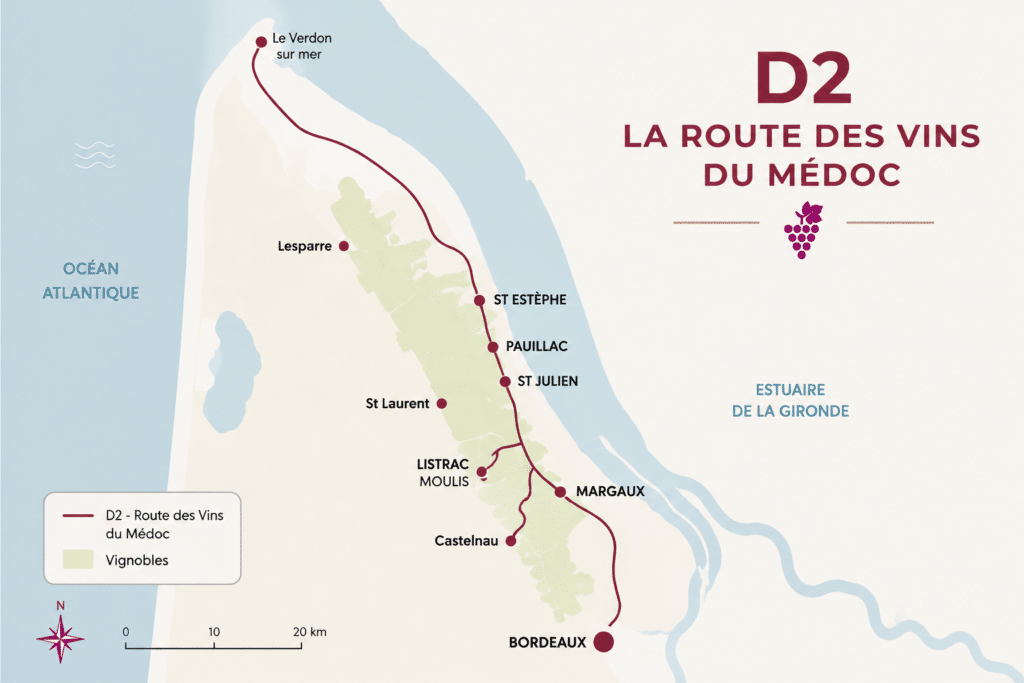
The D2, often called the Route des Médoc or Route des Châteaux, runs the length of the peninsula and passes many of the region’s most famous estates. Most visits require advance booking, particularly at classified growths, and a single day typically allows for two to three unhurried château visits.
Best time to visit and where to stay
Spring and early autumn offer the most comfortable conditions for touring, avoiding both harvest-season congestion and winter’s quieter, more limited opening hours. Pauillac and Margaux serve as convenient bases, each within easy reach of multiple appellations and a manageable drive from central Bordeaux.
In Brief
- Médoc wine comes from eight appellations on Bordeaux’s Left Bank, structured around two regional and six communal designations.
- Cabernet Sauvignon leads the blend across most of the region, complemented by Merlot, Cabernet Franc and Petit Verdot.
- The 1855 Classification ranks sixty Médoc estates across five tiers, anchored by four First Growths.
- Pauillac, Margaux, Saint-Julien and Saint-Estèphe form the historic core of communal prestige, each with a distinct aromatic and structural identity.
- Vintages from 2000 onward confirm the Médoc’s continued capacity for wines of both power and finesse.
Frequently Asked Questions About Médoc Wine
What is Médoc wine exactly?
Médoc wine is red wine produced on the Left Bank of the Gironde estuary in Bordeaux, under one of eight appellations governed by strict production rules regarding grape varieties, yields and geographic boundaries.
What is the difference between Médoc and Haut-Médoc?
Médoc, also called Bas-Médoc, covers the northern half of the peninsula and produces more approachable wines. Haut-Médoc covers the southern two-thirds and contains the six prestigious communal appellations, generally yielding wines of greater structure and aging potential.
What grapes are used in Médoc wine?
Médoc blends rely primarily on Cabernet Sauvignon, typically 60 to 65 percent, alongside Merlot, Cabernet Franc and small amounts of Petit Verdot. Some estates retain minor plantings of Malbec or Carménère.
Which First Growths are in the Médoc?
Four of the five First Growths sit in the Médoc: Château Lafite Rothschild and Château Latour in Pauillac, Château Margaux in Margaux, and Château Mouton Rothschild, also in Pauillac, promoted to First Growth status in 1973.
What is the best vintage of Médoc wine?
There is no single best vintage, but 1982, 2000, 2005, 2010 and 2016 are widely regarded among the finest of recent decades for their combination of ripeness, structure and aging potential.
How long can a Médoc wine age?
Classified growths from strong vintages commonly age for 20 to 40 years, and exceptional vintages can continue developing for half a century or more, particularly wines from Pauillac and Saint-Estèphe.
What does Médoc wine taste like?
Médoc wine typically shows blackcurrant, dark cherry, cedar and graphite notes, with firm tannins in youth that soften into tobacco, leather and dried fruit character with age.
What is the difference between Médoc and Saint-Émilion?
Médoc lies on the Left Bank and favors Cabernet Sauvignon-led blends on gravel soils, while Saint-Émilion sits on the Right Bank and centers on Merlot and Cabernet Franc, grown largely on clay and limestone.
Conclusion
The Médoc rewards a reader willing to move past its reputation and into its structure. Eight appellations, each shaped by a distinct combination of soil, grape and history, produce wines ranging from the accessible reds of the regional Médoc to the collectible First Growths of Pauillac and Margaux. For those considering a closer relationship with the region, whether through acquisition, investment or simply a deeper understanding of what fills the glass, Vineyards-Bordeaux follows the Médoc’s vineyard market closely and welcomes inquiries from buyers exploring the region.
Sources
- Conseil Interprofessionnel du Vin de Bordeaux (CIVB)
- Institut National de l’Origine et de la Qualité (INAO), appellation specifications
- Bordeaux.com, official appellation guides
- Société d’Aménagement Foncier et d’Établissement Rural (SAFER), 2023 land price data
- CNES GeoImage, “Le Médoc, entre vignobles prestigieux et recompositions agricoles,” Eric Sarraute, Université Bordeaux Montaigne
- Agreste Nouvelle-Aquitaine, “La filière viticole girondine : chiffres clés,” June 2026
